


SUNDAY BYTES: The “Main Bhi Hoon” Syndrome
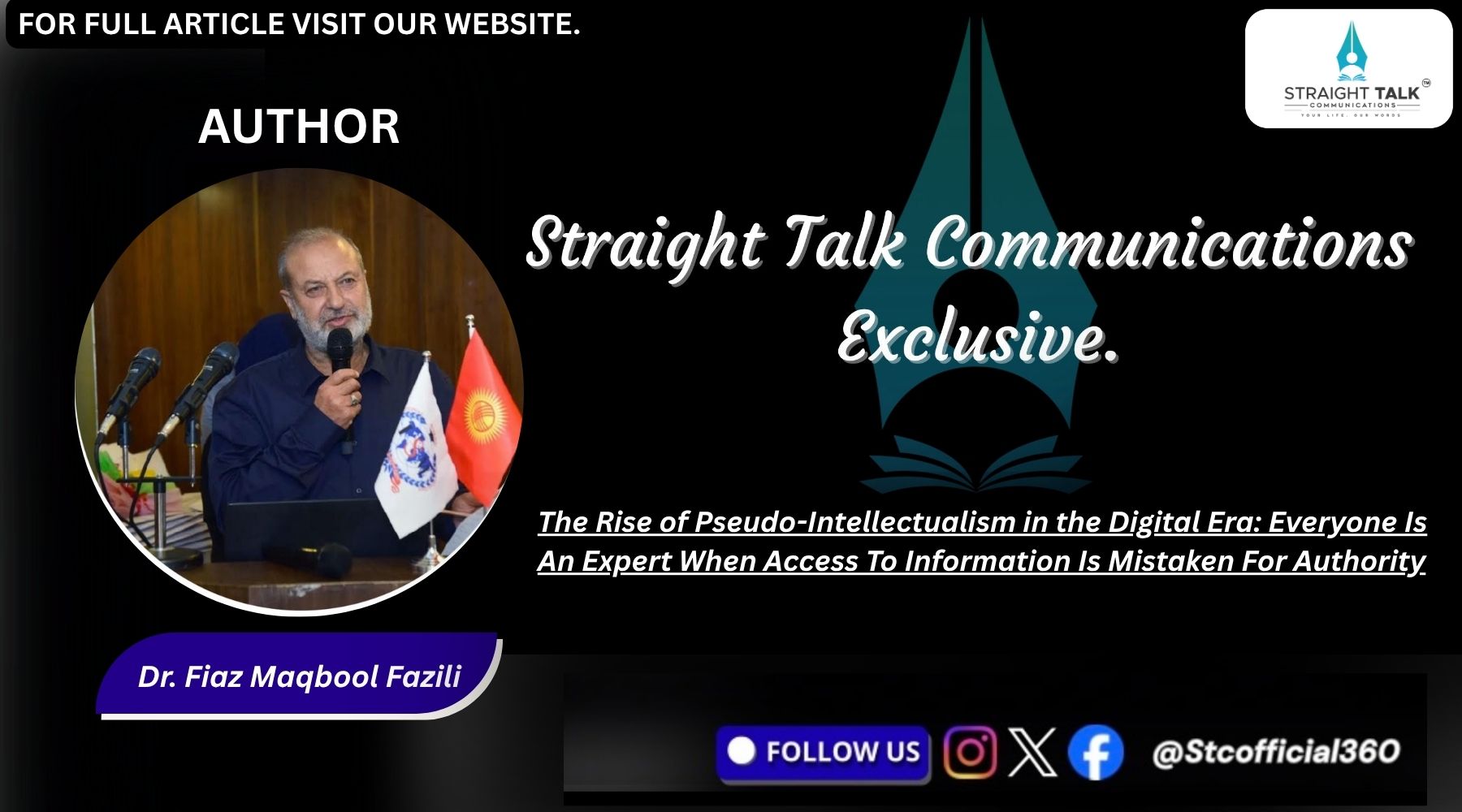
The Rise of Pseudo-Intellectualism in the Digital Era: Everyone Is An Expert When Access To Information Is Mistaken For Authority
Dr. Fiaz Maqbool Fazili
Before social media, Mr. NAM (name and profession changed) was simply an engineering graduate: known to colleagues, family, and a modest professional circle. Then the smartphone turned him into an authority on everything. On politics, he writes, “I think.” On medicine, “I advise.” On road design, “I recommend.” On climate, economics, sports, history, and lately even Islamic jurisprudence, he delivers confident verdicts, often without the training, evidence, or study such subjects demand.
His story is no longer unusual. Social media has created a culture in which everyone wants to be heard, few want to remain students, and the performance of knowledge is often rewarded more than knowledge itself. The problem is not that people have opinions. The problem is that many now mistake opinion for expertise.
The gift and the trap story: the digital revolution has democratized knowledge. A student in a remote village can access university lectures, scientific journals, digital libraries, and experts from across the world. Information, once confined to institutions and elites, is now available to almost everyone. This is a historic achievement. Yet access to information is not mastery of a subject.
Reading a medical article does not make one a physician. Watching a video on structural design does not qualify one to certify a bridge. Following political commentators does not confer expertise in governance or constitutional law. Sharing an environmental infographic does not make someone an ecologist. But the architecture of social media encourages this confusion precisely. Algorithms reward certainty, speed, and controversy. Nuance travels slowly; confidence spreads instantly. As a result, visibility often masquerades as credibility, and confidence as competence.
At the heart of this phenomenon lies a deeply human impulse: Main bhi hoon (“I am here too, visible, relevant, active). People want recognition. They want to be seen, heard, and regarded as intellectually significant. Every trending controversy becomes an opportunity to demonstrate relevance. Silence feels like invisibility; admitting ignorance feels like defeat.So many feel compelled to comment on everything.
Some reinforce this image by posting photographs with politicians, celebrities, senior professionals, or religious scholars. Yet a photograph proves only that two people met. It does not transfer knowledge, experience, or authority.
Often, ignored is the ritual that association is not qualification; proximity is not proficiency. The result is a familiar digital personality: always ready with advice, always eager to comment, and rarely willing to acknowledge the limits of personal understanding.
When experience and expertise become optional, the consequences become serious when pseudo-intellectualism enters specialized fields.
In medicine, rumours become remedies. In engineering, complex matters of structural safety, drainage, transportation systems and traffic flow are reduced to casual observations. Environmental challenges involving climate, ecology and biodiversity are flattened into slogans, while solid waste management, one of the most demanding tests of urban governance, is treated as though it requires little more than common sense. In politics, viral clips substitute for informed analysis. In sports, armchair experts second-guess professionals whose decisions rest on years of training and experience.
We are all entitled to opinions. Yet expertise is earned through study, discipline and humility, not merely through visibility, confidence, or a social media account.
A democratic society requires participation, but participation does not eliminate the value of expertise. Everyone has a right to an opinion. Not every opinion carries equal evidential weight. The sacred frontier: no domain is more vulnerable to the dangers of pseudo-expertise than religion, particularly Fiqh al-Islami, where centuries of scholarship are too often challenged by a few minutes of online browsing.
Islamic jurisprudence is not a matter of personal opinion dressed in religious language. It draws upon the Qur’an, the Sunnah, Arabic linguistics, the sciences and principles of the Qur’an and Hadith, Usul al-Fiqh, and a rich legacy of scholarly inquiry extending over centuries. It is therefore unsurprising that even accomplished scholars may differ, for sincere scholarship often lies not in certainty alone, but in the careful weighing of evidence and interpretation. Yet social media has emboldened many untrained commentators to issue categorical religious judgments after reading a post or watching a short video. Religious claims carry unusual influence because they touch faith, identity, and emotion. When uninformed assertions are presented as unquestionable truth, they can mislead the public, deepen divisions, and distort serious scholarly discourse.
Respecting scholarship does not mean blind obedience. But intellectual freedom does not transform every assertion into scholarship. Psychologists David Dunning and Justin Kruger famously observed that people with limited competence may struggle to recognize the limits of their own competence.
The broader lesson remains timeless: recognizing the limits of our own knowledge is not a sign of weakness but a mark of intellectual maturity. Genuine expertise rarely produces arrogance. More often, it produces caution. The experienced physician recognizes diagnostic uncertainty. The competent engineer understands technical limitations. The serious historian distinguishes evidence from speculation. The learned scholar appreciates the complexity of religious interpretation.
Knowledge encourages questions. Superficial familiarity encourages conclusions. Sometimes the wisest contribution is not a verdict but a question, a qualification, or the simple admission: “I do not know.”
Reclaiming intellectual humility: the major takeaway is that the answer is not to silence ordinary citizens. Experts can be wrong, institutions can fail, and claims should always remain open to scrutiny.
What we need is a culture that values evidence over performance and intellectual honesty over digital applause. Before sharing a claim or commenting, we should ask: What is the source? Is the evidence reliable? Does the speaker possess relevant knowledge? Are alternative explanations being considered? Most importantly, we must restore dignity to the words: “I do not know. “They are not a confession of failure. They are often the beginning of learning.
The digital age has given humanity unprecedented access to information. Whether it creates a more informed society or merely a louder one depends on our ability to distinguish knowledge from noise. Mr. NAM is not the enemy. His desire to participate is entirely human. The problem begins when the desire to be heard overwhelms the willingness to learn. A society cannot progress if everyone insists on being the teacher and nobody is prepared to remain a student. In an age of instant opinions, endless commentary, and manufactured expertise, intellectual humility is not weakness.
It is wisdom.
(STRAIGHT TALK COMMUNICATIONS EXCLUSIVE)