




Every Ambulance Siren Carries Human Story
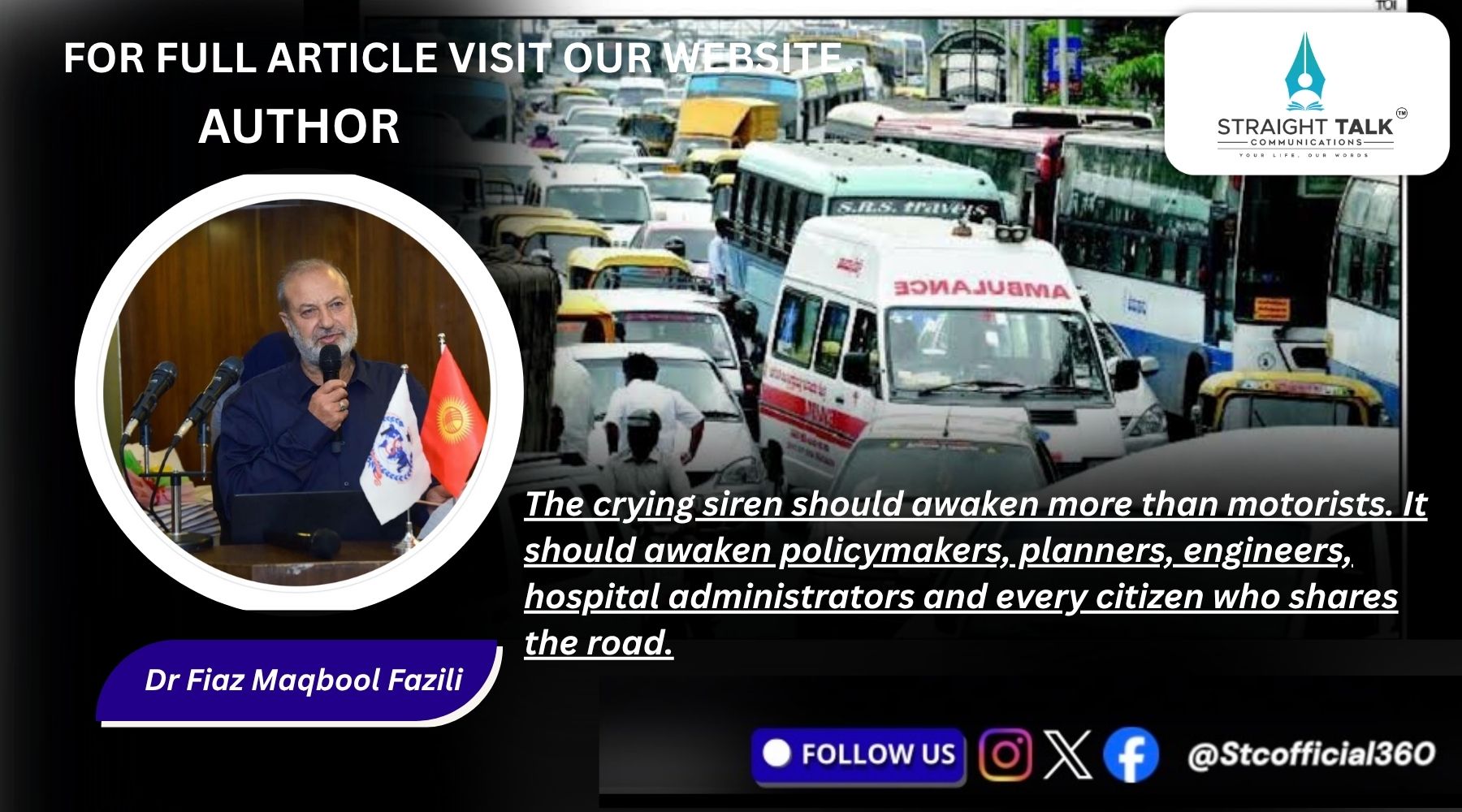
The crying siren should awaken more than motorists. It should awaken policymakers, planners, engineers, hospital administrators and every citizen who shares the road.
Dr Fiaz Maqbool Fazili
Every day in Kashmir, the sound of an ambulance siren echoes through our streets. It is a sound no one likes to hear, because behind every siren is a human story—a child struggling to breathe, a heart attack victim, a pregnant mother with complications, a road accident victim, or a stroke patient racing against time.
Recently, a doctor friend sent me a WhatsApp message that was both emotional and disturbing:
“Since a long time I have been listening to the weeping sound of medical ambulances going to hospitals but unfortunately the sound persists, proving the negligence of our people who don’t give a fig to the vehicle. So many patients die on the way. Is anybody awake in my Gul Posh Valley who would find some solution to the problem? Dr. Fiaz Fazili is especially requested to write on this burning topic as Allah has bestowed him a great pen.”
His words are not merely a complaint. They are an indictment of a healthcare and traffic system that has failed to keep pace with modern medical emergencies.
The problem is far deeper than irresponsible drivers.
The Ambulance Paradox
Governments proudly inaugurate sophisticated ambulances equipped with ventilators, monitors, defibrillators and emergency drugs. They are often described as “mobile ICUs.”
But one uncomfortable question remains.
How will they move?
An ambulance cannot fly.
No amount of technology can compensate for roads that have become parking lots.
On many Srinagar roads there is literally no physical space for vehicles to move aside. Cars stand bumper-to-bumper. Drivers may genuinely wish to give way, yet find themselves trapped by concrete medians, encroachments, narrow roads and endless queues.
The ambulance siren continues to cry.
The patient continues to deteriorate.
The Golden Hour quietly slips away.
A Road Network Designed for Another Era
Much of Kashmir’s urban road network belongs to another generation.
Vehicle ownership has multiplied several-fold over the last few decades, while road capacity has increased only marginally.
Commercial complexes have mushroomed.
Parking spills onto roads.
Footpaths disappear under encroachments.
Intersections choke.
Signal timing is often inadequate.
The result is predictable.
Traffic paralysis.
An ambulance entering such congestion is like a boat entering a frozen river.
The siren becomes a symbol of helplessness rather than hope.
The Golden Hour Is Not a Metaphor
Doctors frequently speak of the Golden Hour, but many outside medicine may not appreciate its significance.
For victims of trauma, severe bleeding, stroke, heart attack and respiratory failure, survival depends on what happens during the first few minutes.
Brain cells die every passing minute during stroke.
Heart muscle dies during myocardial infarction.
Blood loss rapidly progresses to irreversible shock.
Delay kills.
Modern emergency medicine is therefore built around one principle:
Time saved is life saved.
An Ambulance Alone Does Not Save Lives
Many believe that buying more ambulances will solve the problem.
It will not.
An ambulance is only one component of an emergency medical system.
The real system begins much earlier and extends much further.
It starts with the emergency call.
It continues with dispatch.
Traffic control.
Communication.
Pre-hospital treatment.
Hospital preparedness.
Rapid transfer.
Definitive care.
Weakness in any one link weakens the entire chain.
Where Kashmir Falls Behind
Across developed emergency medical systems, a single emergency number activates an integrated network.
Whether it is 911 in North America or similar coordinated systems elsewhere, one call simultaneously alerts dispatchers, ambulance services, police, traffic management and the receiving hospital.
Each agency knows its role.
The nearest appropriate ambulance is dispatched.
Traffic police receive live updates.
Hospitals prepare trauma teams before the patient arrives.
Critical care specialists assemble.
CT scanners are kept ready.
Operating theatres are alerted.
Blood banks prepare.
Every minute is utilised.
Unfortunately, Kashmir still lacks such a fully integrated emergency command-and-control system working round the clock.
Different agencies often function in parallel rather than together.
Communication remains fragmented.
The receiving hospital frequently learns about the patient only when the ambulance reaches its gate.
Preparation begins after arrival instead of before it.
That is valuable time irretrievably lost.
The Importance of Pre-Hospital Care
Emergency care no longer begins inside hospital walls.
It begins at the patient’s side.
Modern ambulance teams should be trained to provide structured assessment using internationally accepted principles such as the ABCDE approach:
Airway with cervical spine protection.
Breathing assessment and oxygenation.
Circulation with bleeding control and shock management.
Disability, including rapid neurological evaluation.
Exposure, while preventing hypothermia and identifying hidden injuries.
This systematic approach ensures that life-threatening problems are recognised and treated before transport is completed.
A moving ambulance should function as the first emergency department—not merely as transport.
Traffic Is a Healthcare Issue
Traffic congestion is often discussed as an inconvenience.
It is actually a public health emergency.
Every blocked intersection may represent delayed thrombolysis for stroke.
Delayed angioplasty for heart attack.
Delayed surgery for internal bleeding.
Delayed ventilation for respiratory failure.
Urban planning and healthcare can no longer be viewed separately.
Road design saves lives.
Public Behaviour Matters Too
Not every delay is due to infrastructure.
Some drivers continue talking on phones.
Others refuse to yield.
Some chase ambulances hoping to exploit the cleared path.
Many panic instead of moving systematically.
Giving way to an ambulance is not merely a traffic rule.
It is a moral duty.
One day the patient inside may be someone from our own family.
Public awareness must therefore begin in schools, driving schools, licensing authorities and media campaigns.
Respect for emergency vehicles should become a social norm.
Technology Can Help
Technology offers solutions if intelligently deployed.
GPS-enabled ambulances linked to a central command centre can identify the nearest available unit.
Real-time traffic monitoring can recommend the fastest route.
Adaptive traffic signals can create a “green corridor” automatically.
Hospitals can receive patient information electronically while the ambulance is still en route.
Police control rooms, emergency physicians and ambulance crews can communicate continuously through a common digital platform.
These are no longer futuristic concepts.
They are standard practice in many advanced emergency systems.
What Kashmir Needs
The solution lies not in purchasing more ambulances alone but in redesigning the entire emergency response ecosystem.
Kashmir should establish a unified Emergency Medical Services Authority integrating health services, police, traffic, fire services and disaster management under a single 24×7 command-and-control centre.
Professional emergency medical dispatchers should triage every call and deploy the appropriate response without delay.
Ambulance personnel must be trained and regularly certified in Basic Life Support, Advanced Cardiac Life Support, Pre-Hospital Trauma Life Support and paediatric emergencies.
Traffic management should include legally protected ambulance corridors wherever feasible, adaptive traffic signalling, strict enforcement against obstruction of emergency vehicles and public education campaigns.
Hospitals must maintain real-time communication with ambulances so that emergency physicians, surgeons, anaesthetists, cath labs, trauma teams, CT scanners and blood banks are activated before arrival rather than after it.
Regular multi-agency mock drills involving hospitals, police, traffic authorities and disaster management should test preparedness and identify system failures before real emergencies expose them.
A Change in Mindset
Emergency medicine has evolved dramatically.
We no longer judge healthcare by the sophistication of hospital buildings alone.
We judge it by how quickly the right care reaches the right patient at the right time.
The ambulance is only one visible part of that chain.
The invisible system behind it determines whether the patient lives or dies.
The Siren Is Asking Us a Question
Every ambulance siren asks a silent question.
Are we merely hearing the sound, or are we listening to its message?
A society that cannot create a clear path for an ambulance is not merely facing a traffic problem.
It is confronting a systems problem involving urban planning, emergency medicine, governance, law enforcement and civic responsibility.
The crying siren should awaken more than motorists. It should awaken policymakers, planners, engineers, hospital administrators and every citizen who shares the road.
Because the next ambulance trapped in traffic may not be carrying a stranger.
It may be carrying someone we love.
And when that day comes, we will not ask how advanced the ambulance was.
We will ask only one question:
Why did it never reach in time?
( Author a Senior Consultant Acute care Surgery and healthcare policy analyst with expertise in quality assurance, patient safety, and emergency medical systems. , and worked with JCi and Ge Healthcare international for health ministry policy, plans and projects for improving emergenciesz He is a regular columnist on healthcare reforms and public policy.
(STRAIGHT TALK COMMUNICATIONS EXCLUSIVE)