

FRIDAY SERMON : Upbringing – A Comprehensive Concept in Islamic Ideology
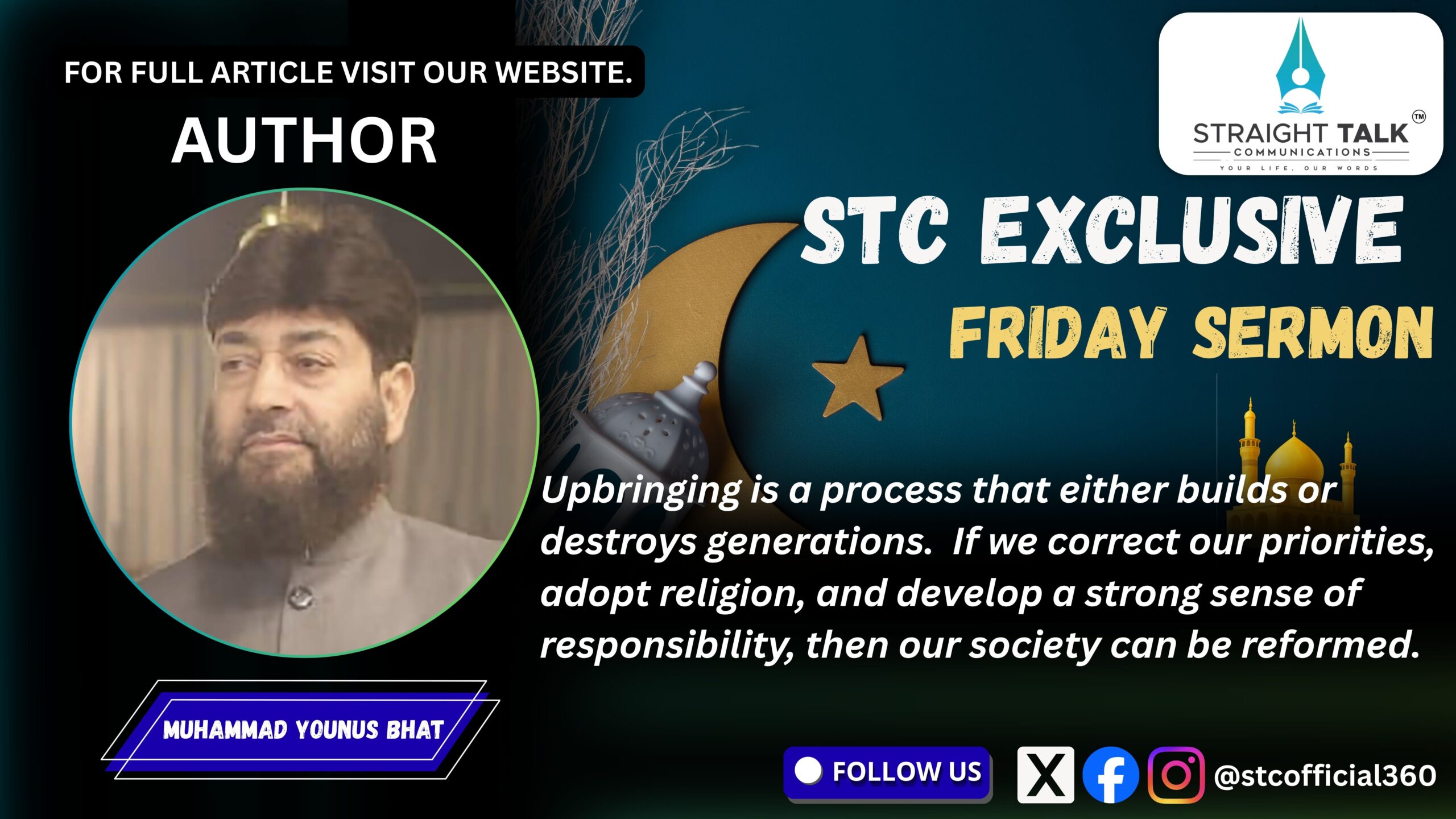
Upbringing is a process that either builds or destroys generations. If we correct our priorities, adopt religion, and develop a strong sense of responsibility, then our society can be reformed.
Muhammad Younus Bhat (Zahid)
Human life begins as a tiny being, yet within that tiny being lies an entire world. The direction in which this world will grow and flourish depends entirely on upbringing (parwarish). Upbringing is the foundation upon which the structure of an individual, a family, and an entire nation is built.
Islam has not considered upbringing merely a worldly need, but a religious obligation. This is why the Quran and Hadith repeatedly emphasize the responsibilities towards children.
Difference Between Upbringing and Training
Most people consider upbringing and training to be the same, but in reality, they are two distinct yet complementary processes.
Upbringing (Parwarish):
- Physical growth and development
- Mental and emotional growth
- Providing a suitable environment
- Protection, love, and care
Training (Tarbiyat):
- Building of moral character
- Religious education
- Teaching manners and etiquette
Summary:
Upbringing is the soil, and training is the seed. Even if the seed is excellent, it will not bear fruit if the soil is not fertile.
Upbringing and the Construction of Generations
A child is not merely an individual; he is the representative of future generations.
If his upbringing is proper, he becomes:
- A good son
- A good husband
- A good father
In this way, the correct upbringing of one individual positively influences the entire society.
Importance of Upbringing in Islamic Teachings
In Islam, children are regarded as a trust (amanat) from Allah.
Hadith:
“Every one of you is a shepherd and will be questioned about his flock.”
This means:
- Parents are responsible for their children
- Teachers are responsible for their students
- Society is responsible for its members Role of Parents: The First School
A child learns first and foremost from his parents.
Mother’s Role:
- Love, tenderness, and sacrifice
- Laying the foundation of moral values
Father’s Role:
- Discipline and order
- Practical guidance for life
When the home environment is right, the child naturally grows into a good human being.
Mother’s Lap: The First University
The mother’s lap is called the first school.
Even before learning to speak, a child begins to understand his mother’s behavior.
- Her tone of voice
- Her patience
- Her worship and devotion
All of these become part of the child’s personality.
Today’s Society: Shifted Priorities
We are living in a strange era where:
- Millions of rupees are spent on animals
- Children are not given time
- Parents and elders are neglected
In homes, keeping dogs and cats has become a fashion, while:
- Children yearn for love
- The elderly live in loneliness
This situation is a clear sign of our social decline.
Kindness to Animals and Moderation
Islam forbids cruelty to animals, but it also teaches moderation (i’tidal).
Islamic principle:
Balance Neither be cruel to animals, nor violate the rights of human beings.
If humans are hungry on one side and luxurious spending is done on animals on the other, this is not moderation — it is excess and imbalance.
Upbringing: A Great Trust
Upbringing is not just a responsibility but a sacred trust (amanat), especially in the case of:
- Orphaned children
- Children entrusted to someone’s care
In raising such children, justice, love, and honesty are extremely important.
Status of Raising Orphans in Islam
Islam has given great reward for raising orphans.
- Not hurting an orphan’s feelings
- Protecting his property
- Safeguarding his self-respect
All of these are part of proper upbringing.
Relationship Between Education and Upbringing
Upbringing is not limited to food, clothing, and shelter. It also includes:
- Religious education
- Worldly education
- Awareness and consciousness
These are all essential parts of complete upbringing.
Need for a Free Environment
A child must be given an environment where he can:
- Ask questions
- Express his opinion
- Learn freely
Consequences of excessive strictness:
- Fear
- Lying
- Rebellion
Consequences of excessive freedom:
- Waywardness
- Disrespect
Islamic Path: Moderation.
Challenges of the Modern Age
- Mobile Phones and Social Media
- Wastage of time
- Moral corruption
- Mental stress
- Parents’ Busyness
- Lack of time for children
- Emotional vacuum
- Education System
- Focus only on degrees
- Lack of character building
Practical Example (Civic Sense)
There is an incident where a person saw a water tap running on the street for two days, yet no one turned it off.
This was not just a tap it reflected:
- Our indifference
- Our lack of responsibility
Similarly, if we show negligence in the upbringing of our children, the entire society will suffer.
Harm of Pressure and Competition
Today, parents put children under pressure for:
- Marks
- Competition
- Success
But they forget that every child has unique abilities.
Role of Religion in Upbringing
If religion is not included in upbringing:
- Morality disappears
- Sense of responsibility vanishes
Religion teaches us:
- Rights of people (Huqooq-ul-Ibad)
- Patience
- Gratitude
- Importance of Rights of People*
Life is an examination. Just as a student works hard to get good marks, a human being should:
- Fulfill the rights of others
- Practice justice
- Avoid causing harm to anyone
Principles of Ideal Upbringing
- Love and affection
- Moderation
- Religious education
- Practical example (role modeling)
- Giving time
- Justice
Society’s Responsibility
Upbringing is not only the duty of parents, but also of:
- Teachers
- Scholars
- Neighbors
- The entire society Conclusion
Upbringing is a process that either builds or destroys generations.
If we correct our priorities, adopt religion, and develop a strong sense of responsibility, then:
- Our society can be reformed
- Our future generations can be better
Remember:
Today’s upbringing is tomorrow’s society.
And Allah knows best
(STRAIGHT TALK COMMUNICATIONS EXCLUSIVE. Makahmadina11@gmail.com)