
SUNDAY BYTES: The Lost Art of Healing – Nobility, Compassion, and the Real Measure of a Doctor
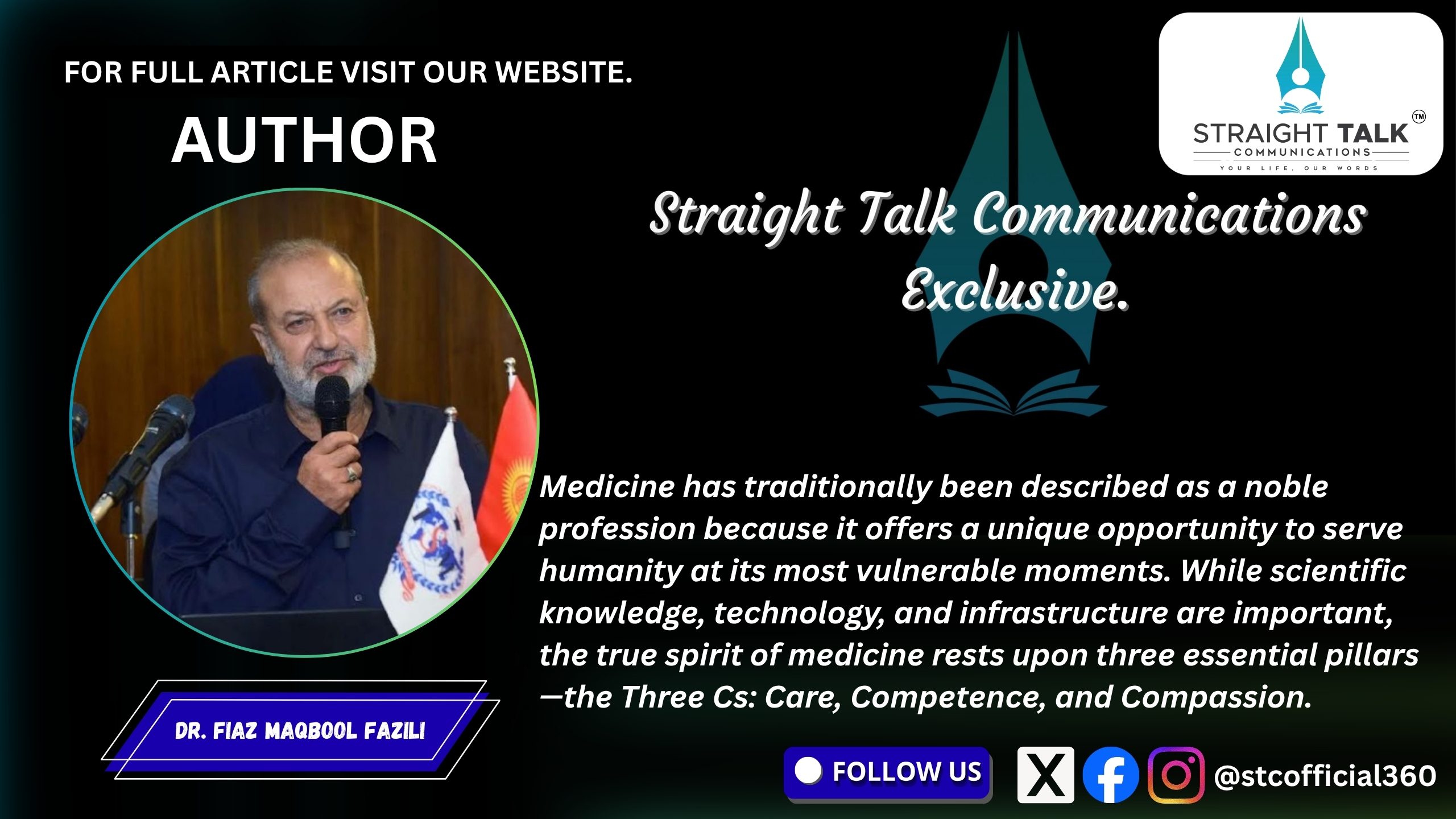
Medicine has traditionally been described as a noble profession because it offers a unique opportunity to serve humanity at its most vulnerable moments. While scientific knowledge, technology, and infrastructure are important, the true spirit of medicine rests upon three essential pillars—the Three Cs: Care, Competence, and Compassion.
Dr. Fiaz Maqbool Fazili
Medicine has long been regarded as a noble profession. It is not merely a career, a source of livelihood, or a pathway to prestige. At its finest, medicine is a calling—a sacred trust between a suffering human being and another human being who has pledged to help. The true nobility of medicine lies not in degrees, titles, academic achievements, or surgical skills alone, but in the opportunity, it provides every day to display empathy, compassion, kindness, and humanity.
In an era dominated by technology, artificial intelligence, digital diagnostics, and sophisticated therapeutics, one important question remains unanswered: Where is the real doctor?
Not many doctors tell stories about their most recent rewarding patient encounters, yet most would agree that medicine remains one of the most important and, unfortunately, one of the least appreciated professions, particularly in our part of the world. Gratitude has become rare. A simple “thank you” from a patient or family member can uplift an exhausted healthcare worker more than any financial reward or professional recognition. It reminds us why we entered this profession in the first place.
There was a time when doctors were trusted. There was a time when they were not considered guilty until proven otherwise. Their prescriptions were accepted with confidence and judged through their competence and integrity . Today, that trust has been severely eroded. Doctors frequently find themselves in the news for the wrong reasons, accused of kickbacks and cuts on prescription’ medicine and tests . Public perception has shifted from viewing medicine as a noble service to seeing it as a commercial enterprise.
To be fair, some of this criticism is justified. A small minority of healthcare providers have compromised ethical standards through kickback-driven prescriptions, unnecessary investigations, questionable procedures, and unhealthy alliances with pharmaceutical companies, private hospitals, and diagnostic centres. Such practices stain the reputation of the entire profession and create an atmosphere of distrust.
However, the misconduct of a few should never define the many. The overwhelming majority of doctors continue to serve with honesty, dedication, and sacrifice. To protect the morale of these professionals, wrongdoing must be dealt with firmly and transparently. Equally important is responsible reporting by the media, which must distinguish between isolated misconduct and systemic realities.
Yet, if we are honest with ourselves, the crisis of trust is not solely about corruption. Much of it stems from something simpler and far more fixable—communication.
Patients rarely expect miracles. What they seek is understanding. They want someone to listen to their fears, explain their options, answer their questions, answer their quiries either by cellphone ot whatsap and stand beside them during moments of uncertainty. Unfortunately, many healthcare workers, despite excellent clinical competence, struggle to communicate effectively, don’t resond keep WhatsApp closed or don’t respond. Risks, benefits, alternatives, and expected outcomes are often inadequately explained. Families are left confused and unprepared for complications or adverse outcomes. When expectations are not managed, frustration turns into anger, and anger is often directed at the doctor.
The reality is that people do not care how much you know until they know how much you care.
A good doctor remembers that every patient is more than a diagnosis, laboratory report, or radiological image. Every patient is a human being carrying fears, hopes, responsibilities, dreams, and anxieties. The healing process begins not with a prescription but with a conversation.
An elderly patient once told me, “Doctor Sahib, your medicines helped me, but your words healed me.”That statement captures the essence of noble medical practice.
The Prophet Muhammad (peace be upon him) taught us the value of relieving human suffering. He said that whoever alleviates the hardship of another person, Allah will alleviate his hardships in this world and the Hereafter. Every day, doctors are presented with opportunities to earn such rewards. Sometimes it requires no prescription, procedure, or operation. Sometimes all that is needed is a kind word, a reassuring smile, a gentle touch, or a few extra minutes spent listening.
The sincere prayers of patients and their families are among the greatest blessings a healthcare worker can receive. These prayers cannot be bought. They are earned through compassion.
Years ago, healthcare was largely physician-centred. The doctor decided what was best, and patients followed instructions. Today, healthcare has evolved into a patient-centred model that respects dignity, autonomy, and shared decision-making. This transformation is not only desirable but necessary. Unfortunately, communication skills are often neglected in medical training. Medical students spend years mastering anatomy, physiology, pathology, pharmacology, and surgery, yet receive little formal instruction on how to communicate with a grieving family, support a frightened patient, or manage emotional conversations.
As a result, many doctors rely solely on instinct.
The consequences are evident. The most common complaint about physicians worldwide is not lack of competence but lack of communication. Patients frequently say, “The doctor didn’t listen to me,” or “The doctor didn’t explain anything.”
Good communication is not a soft skill; it is a clinical skill. Effective doctor-patient communication improves adherence to treatment, reduces complaints, strengthens trust, and contributes to better health outcomes.
Healthcare institutions must recognize this reality. Communication training should become an integral part of medical education and professional development. Doctors must learn how to listen actively, express empathy, deliver difficult news sensitively, and engage patients as partners in their care.
At the same time, society must also understand the realities of modern healthcare.
Healthcare is inherently complex and risk-prone. Not every complication is negligence. Not every adverse outcome is a medical error. Studies consistently show that many adverse events result from systemic weaknesses rather than individual incompetence. Lack of protocols, inadequate infrastructure, shortages of staff, defective equipment, overcrowding, and administrative failures often contribute to poor outcomes. Yet public anger is frequently directed at frontline healthcare workers.
Doctors today work under extraordinary pressures, meagre salaries and outdated infrastructure . Long hours, overcrowded clinics, staff shortages, endless documentation, rising litigation, social media scrutiny, and unrealistic expectations have created unprecedented levels of professional burnout. Surveys worldwide reveal alarming levels of dissatisfaction among physicians. Many are uncertain whether they would recommend medicine to their children.
This should concern all of us.
A demoralized doctor cannot deliver optimal care. A healthcare system that constantly blames its workforce while ignoring systemic deficiencies is destined to struggle.The solution lies not in assigning blame but in rebuilding trust.
Patients have rights, but they also have responsibilities. Doctors deserve accountability, but they also deserve respect. Hospital administrators must protect both patient welfare and staff safety. Media must report responsibly. Policymakers must strengthen systems rather than seek convenient scapegoats.Above all, healthcare professionals must reclaim the human side of medicine.
What truly makes a good doctor? It is certainly not the career highlights , number of certificates hanging on a wall.It is not academic titles, awards, how much crowded is your clinic or social media popularity.A good doctor combines competence with character, empathy. Knowledge with humility. Science with compassion. Patients consistently tell us they want doctors who listen, communicate honestly, explain clearly, treat them with dignity, and genuinely care about their wellbeing.
The healing power of kindness is often underestimated. A smile, a comforting hand on the shoulder, a few encouraging words, a sincere effort to understand someone’s fears—these simple acts can profoundly influence a patient’s journey. Thus, the Three Cs—Care, Competence, and Compassion—are not merely professional virtues. They are pathways to restoring trust, preserving the nobility of medicine, and transforming daily work into an enduring act of charity. A doctor may complete hundreds of consultations in a week and forget many prescriptions written, but patients rarely forget how they were treated. Long after medicines are finished and wounds have healed, they remember the doctor who listened, cared, and stood beside them during difficult times.
The real wealth of a healthcare professional is not measured by income, titles, or recognition, but by the sincere prayers of patients and families whose burdens were lightened through his or her service. Those prayers are often the greatest reward for a life dedicated to healing.
In the end, medicine is not only about curing disease. It is about caring for people.Technology will continue to evolve. Artificial intelligence may assist diagnosis. Machines may perform increasingly sophisticated tasks. Yet no technology can replace human compassion, empathy, and emotional connection. The future of medicine will depend not merely on scientific advancement but on our ability to preserve the values that made this profession noble in the first place.
The real doctor is not lost. He or she is found every day in crowded wards, emergency rooms, clinics, operating theatres, and rural health centres—where dedicated professionals continue to serve despite immense challenges.
Let us restore trust by restoring humanity. For beyond pens, prescriptions, and procedures lies the true heart of medicine: a tender heart, caring hands, and an unwavering commitment to relieve human suffering. That is nobility. That is healing. And that is what makes a good doctor.
(STRAIGHT TALK COMMUNICATIONS EXCLUSIVE. The author is practicing surgeon, clinical auditor, and accreditation assessor.)