


Nation First: Collectively, we stand for it’s glory
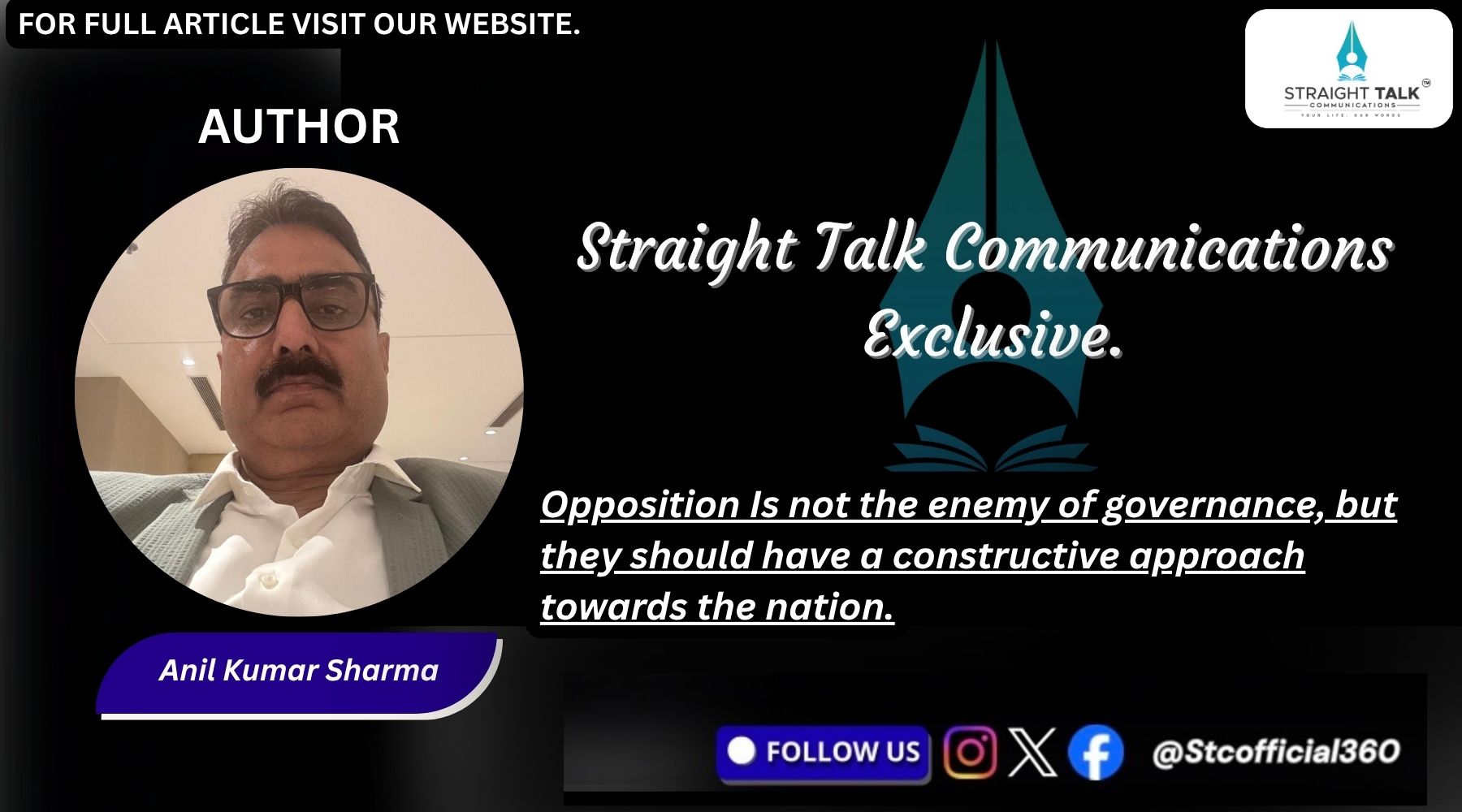
Opposition Is not the enemy of governance, but they should have a constructive approach towards the nation.
Anil Kumar Sharma
In a democracy, the role of the opposition is not merely to oppose. It is to question, scrutinise, challenge and, where necessary, offer an alternative. The opposition is an essential part of parliamentary democracy because it keeps the government accountable to the people. Even Parliament’s own material describes the Opposition as having the responsibility to ensure accountability and present alternatives to government policies and proposals.
But somewhere along the way, the meaning of opposition seems to have changed. Today, almost every initiative of a government is viewed through the political prism of who proposed it rather than what it seeks to achieve. A policy is criticised before its purpose is understood, a reform is opposed before its long term implications are examined and a government decision becomes an opportunity for mudslinging. Criticism is necessary in a democracy, but criticism without understanding can become an obstacle to governance itself.
There is another disturbing tendency. Whenever there is an uprising, agitation or public discontent in some part of the country, political leaders often rush to occupy the space. Genuine grievances of citizens certainly deserve to be heard and addressed. But when legitimate concerns are converted into political mobilisation by ambitious leaders who see an opportunity to strengthen their own position, the larger national interest can easily get lost. The question should not always be who can extract political advantage from a situation, but what can resolve the problem permanently.
Our society too has become increasingly divided in its political responses. On one side are those who support the government almost unquestioningly, sometimes reducing every disagreement to disloyalty. On the other are those who appear to see an opportunity in every government initiative to discredit the ruling party. Between these two extremes lies the silent majority, which perhaps wants neither blind support nor blind opposition. It simply wants good governance.
This is where we need to rediscover the real meaning of democracy. The Constitution describes India as a Union of States and establishes a parliamentary system in which the executive remains accountable to Parliament. Democracy, therefore, was never designed to create permanent enemies. The government and the opposition may stand on different sides of the House, but both ultimately draw their authority from the same people and are expected to work within the same constitutional framework.
India’s social complexity makes this responsibility even greater. We are a country of many religions, castes, languages, communities and traditions. This diversity is our strength, but it can also become vulnerable when community identity is placed above national interest. Political leaders, therefore, carry a special responsibility not to reduce citizens into vote banks or communities. Religion, caste and regional identity may shape our social lives, but the Constitution binds us together as citizens of one nation.
At the same time, the ruling party must also look beyond the temptation of presenting every period of its tenure as a golden age. No government inherits a blank slate, and no government creates a nation from scratch. Every generation inherits something from the previous one and leaves something for the next. India today is the product of a long and complicated journey in which different leaders, governments, institutions and ordinary citizens have played their part.
We should therefore resist the temptation to either glorify or dismiss an entire era. Jawaharlal Nehru belonged to a very different India, emerging from colonial rule and attempting to build democratic institutions, scientific capacity and an industrial base. Indira Gandhi governed in another period, marked by wars, political upheavals and major economic and social challenges. P.V. Narasimha Rao and Manmohan Singh were associated with the economic transformation that began in 1991. The reforms of 1991 represented a significant shift towards a more open and market-oriented economy. Atal Bihari Vajpayee’s period too contributed to India’s economic and infrastructural trajectory. Narendra Modi represents the present phase, with emphasis on infrastructure, digital public systems, manufacturing, investment and India’s growing engagement with the world. These are different chapters of the same national story, not mutually exclusive histories.
This is perhaps where we need to change our political vocabulary. We should stop looking at India as a possession of one political party or one leader. India belongs to all of us. Governments change, opposition parties change, leaders change and political slogans change, but the nation continues.
Our contemporary neighbourhood also offers an important lesson. At the time of the subcontinent’s partition, India and Pakistan emerged from the same historical experience, facing many of the same challenges of poverty, displacement, institution building and nation making. Yet, over the decades, their political and economic journeys have taken very different directions. Pakistan has repeatedly faced political instability, institutional tensions, economic crises and dependence on external financial support.
This should not be read as a celebration of another country’s difficulties. It should instead remind us of the consequences when short-term political survival takes precedence over institution building and long-term national interest. The IMF has also identified weak governance, social tensions, economic pressures and political instability as factors that can reinforce fragility in states.
I sometimes look at India’s journey like a hockey team. Every player does not perform the same role, but every role matters. One player defends, another builds the attack, another creates the opportunity and someone else finishes it. In my metaphor, Nehru may be seen as one of the defenders who helped establish the early institutional foundations; Indira Gandhi as a midfielder who played through a turbulent phase of nation building; Manmohan Singh as the player who helped create and execute a major economic opening; and Narendra Modi as the centre forward of the present phase, taking the country forward with his own priorities and style.
The metaphor is not about declaring one player better than another. It is about understanding that Team India has never been the work of one individual. A goal scored today may have been made possible by a pass given decades earlier.
Even the famous doubts expressed by Winston Churchill about India’s ability to sustain itself after British departure have to be viewed in their historical context rather than turned into a convenient political slogan. Churchill was a strong opponent of Indian independence and held deeply pessimistic views about the consequences of British withdrawal. History, however, took a different course. India did not disappear after independence. It built institutions, survived enormous social and political challenges, remained a constitutional democracy and continued to evolve.
That evolution has not been smooth. We have made mistakes, taken wrong turns, faced wars, economic crises, political instability and social tensions. Yet the country has continued to move. The 1991 economic crisis, for example, became the backdrop for reforms that fundamentally changed the direction of the Indian economy. That itself teaches us something important: sometimes the India of today is built upon decisions taken during circumstances that were very different from the present.
Therefore, the opposition should oppose where opposition is necessary. It should expose wrongdoing, question expenditure, demand transparency, protect constitutional rights and speak for citizens whose voices may otherwise remain unheard. But it should also have the courage to say when a government decision is in the national interest. Parliamentary material has itself emphasised that opposition should not become opposition merely for its own sake, but should remain constructive and meaningful while keeping the larger national interest in mind.
Similarly, the government must learn to accept criticism without treating every critic as an adversary. A government that listens to criticism can correct its mistakes before they become crises. An opposition that refuses to acknowledge anything positive loses the credibility needed to question what is genuinely wrong.
India does not need an army of andh bhakts, nor does it need an army of permanent fault-finders. It needs citizens who can appreciate good work without surrendering their judgement and question bad decisions without hatred.
The real test of our democracy is not whether the government wins every argument or whether the opposition defeats every proposal. The real test is whether, after all the arguments are over, India moves forward.
India’s greatest achievement, therefore, is not that one government has done more than another. It is that despite enormous diversity, political disagreements, wars, economic crises, social tensions and changes of government, the Indian experiment has continued. We have remained a Union, a constitutional democracy and an evolving economy. That continuity is the collective contribution of generations of leaders and citizens.
Because governments may claim the credit, opposition parties may claim the correction, and leaders may claim the vision. But the journey belongs to the nation.
“The jersey may change, the players may change,
the strategy may change with time;
but the team must remain India,
and the goal must remain the nation.”
(STRAIGHT TALK COMMUNICATIONS EXCLUSIVE)
(Disclaimer: The views are of the author and not of the Straight Talk Communications)