


Reading: The Foundation of Great Writing
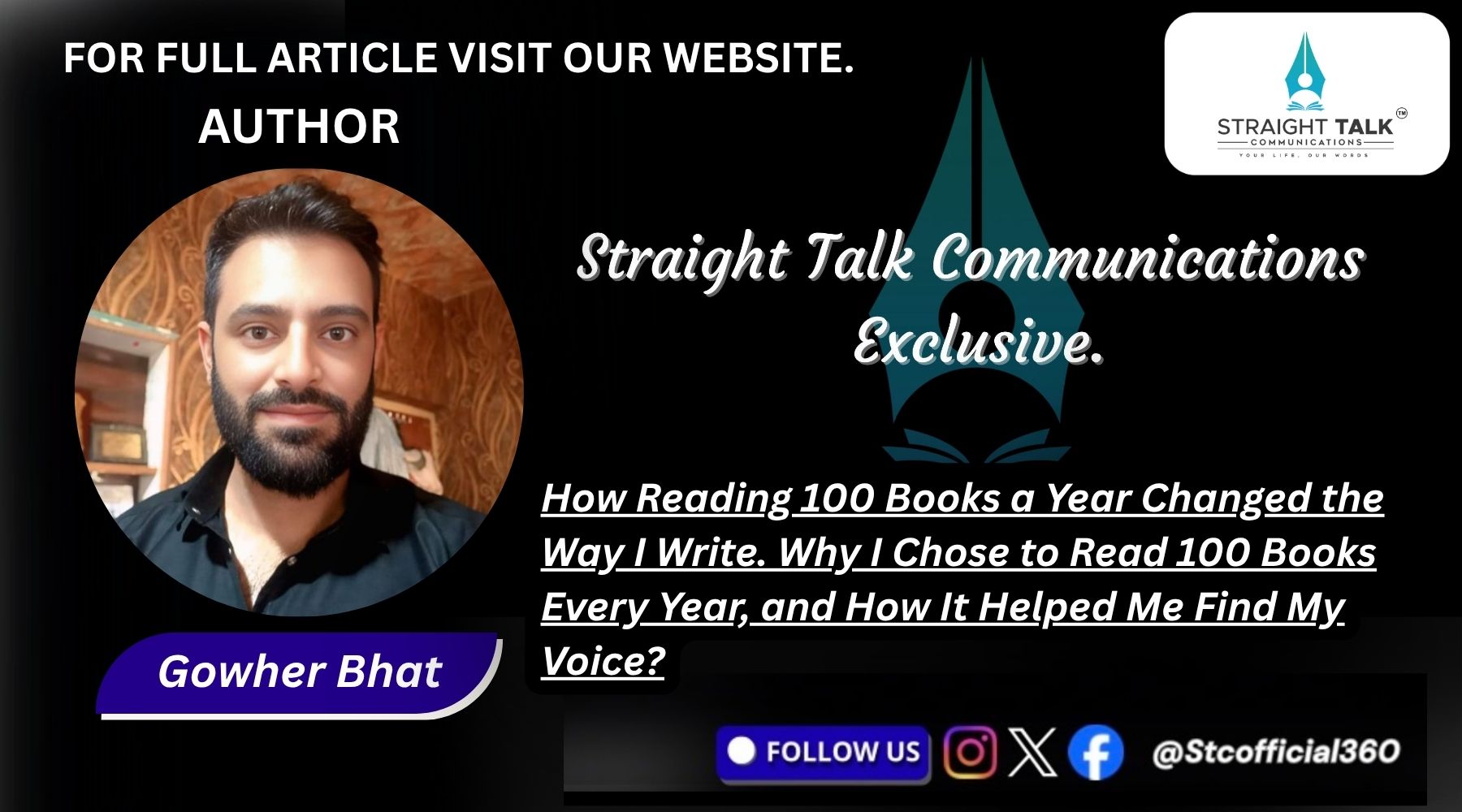
How Reading 100 Books a Year Changed the Way I Write. Why I Chose to Read 100 Books Every Year, and How It Helped Me Find My Voice?
Gowher Bhat
There comes a moment in every writer’s life when they realise that talent alone is not enough. Words do not appear by magic. They are shaped quietly, page by page, book by book, over years of reading.
Nearly a decade ago, I made a decision that transformed not only my writing but also the way I looked at life. I promised myself that I would read 100 books every year. It sounded ambitious, perhaps even unrealistic, but I knew that if I truly wanted to become a better writer, I first had to become a better reader.
The mathematics was surprisingly simple. One hundred books a year meant reading roughly two books every week. It meant setting aside a few uninterrupted hours every day to read instead of spending that time on endless scrolling or other distractions. More than speed, it demanded consistency. More than motivation, it required discipline.
At first, maintaining the habit was not easy. Some books tested my patience, while others captivated me from the very first page. But gradually, reading stopped feeling like a goal to achieve. It became a way of life, something I looked forward to every single day.
The greatest gift reading gave me was not knowledge alone. It gave me language. Every novel introduced me to new vocabulary. Every biography revealed a different way of telling a story. Every essay taught me clarity of thought, and every poem reminded me that a handful of carefully chosen words can often say more than pages of unnecessary sentences.
People often ask me how writers improve their craft. My answer has always been the same: read, then read some more. Reading is the foundation of great writing. Just as a tree cannot grow strong without deep roots, a writer cannot truly develop without reading. Books nourish the mind with fresh ideas, enrich vocabulary, sharpen imagination, and deepen our understanding of language. They introduce us to different voices, styles, perspectives, and ways of thinking. Without reading widely and consistently, even the most talented writer will eventually run short of inspiration, creativity, and the ability to express ideas with depth, clarity, and originality.
The more I read, the more naturally words began to flow onto the page. I no longer struggled to find the right expression. Ideas connected more effortlessly. Paragraphs became smoother, and storytelling felt more natural. Looking back at my earlier work, I can clearly see how years of reading gradually shaped my writing and strengthened my confidence as a writer.
Reading also taught me something equally valuable. It showed me what to avoid. Weak characters, repetitive language, confusing plots, and poor storytelling became easier to recognise. By learning from both great books and imperfect ones, I gradually refined my own writing and developed a voice that felt increasingly authentic.
Perhaps the greatest gift of reading is that it allows us to live hundreds of lives while remaining on our own. Through books, I have travelled across continents without leaving my chair. I have walked through ancient kingdoms, sailed stormy seas, explored distant planets, solved mysteries, and witnessed moments of history. I have experienced emotions, cultures, and perspectives that I might never encounter in real life.
Reading is the greatest escape ever created. Whenever life becomes overwhelming, a book opens the door to another world. For a while, worries fade, the noise of everyday life grows quieter, and imagination takes over. Few things possess the remarkable ability to comfort, inspire, and heal the mind the way a good book does.
Over the past decade, I have read hundreds of books spanning fiction, history, biographies, memoirs, philosophy, psychology, literature, and contemporary writing. Every book has left something behind, a new perspective, a memorable sentence, an unforgettable character, or simply a reminder that learning never ends. With every book, I discovered something new, not only about literature but also about people, the world, and myself.
The relationship between reading and writing is beautifully simple. Reading fills the mind with ideas, experiences, emotions, and knowledge. Writing gives those thoughts a voice. The richer our reading, the richer our writing becomes. Every page we read adds another layer to our understanding of the world and another tool to our craft as writers.
Reading is far more than a hobby. It is an investment in ourselves. Every page broadens our perspective. Every chapter strengthens our imagination. Every finished book makes us a little wiser than we were the day before. And contrary to what many people believe, reading is fun. It is an adventure without tickets, a journey without borders, a classroom without examinations, and a lifelong companion that asks for nothing except our time and curiosity.
Looking back, my journey of reading 100 books a year has never really been about reaching a number. The number simply keeps me accountable. The real reward has been the quiet growth that comes with every finished book, the new ideas, fresh perspectives, and deeper appreciation for language that stay with me long after I turn the final page.
If you dream of becoming a better writer, begin by becoming a devoted reader. Read every day. Read widely. Read with curiosity. Because every great writer is, first and foremost, a great reader.
(STRAIGHT TALK COMMUNICATIONS EXCLUSIVE)