


The Promise That Outweighed A Dream
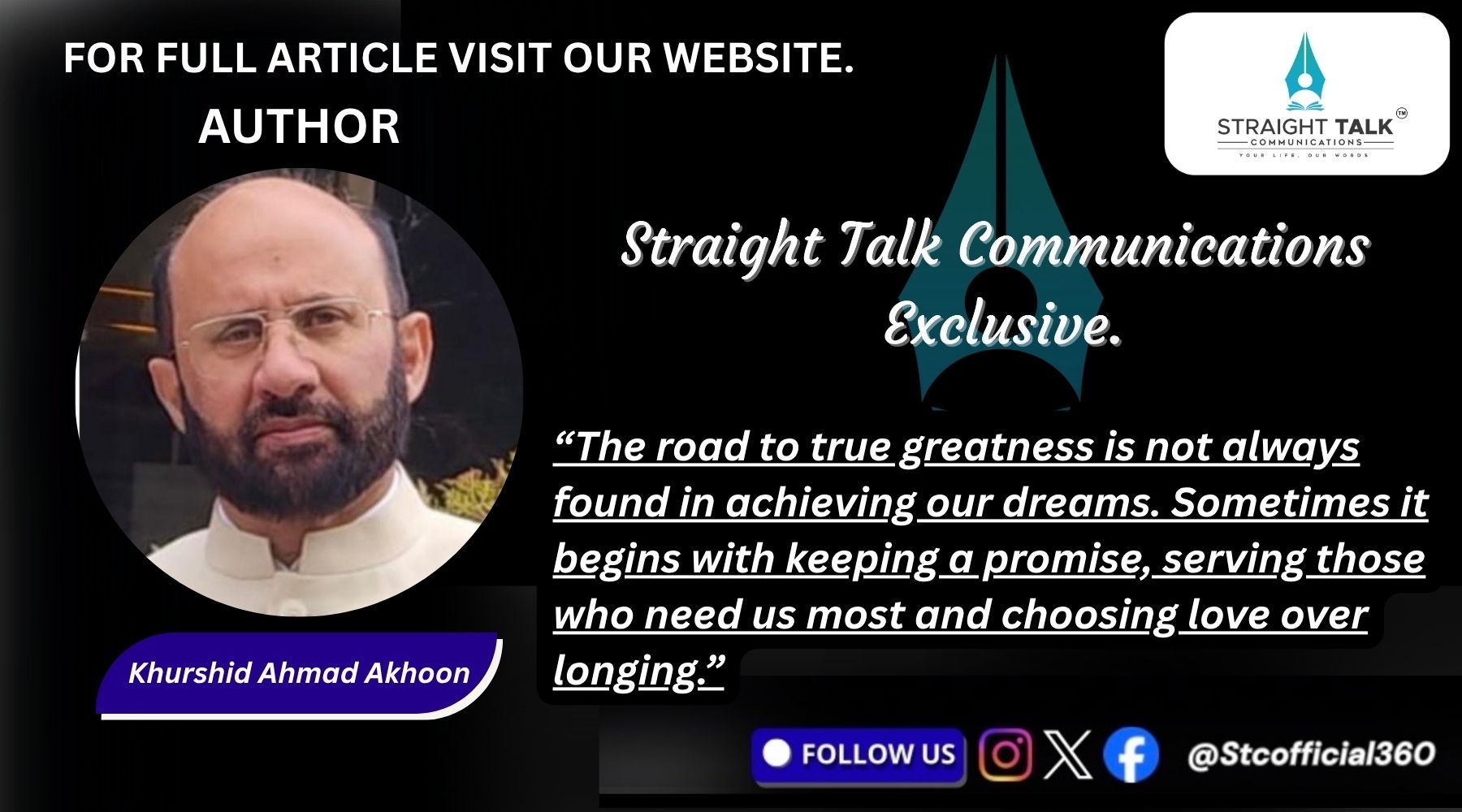
“The road to true greatness is not always found in achieving our dreams. Sometimes it begins with keeping a promise, serving those who need us most and choosing love over longing.”
Khurshid Ahmad Akhoon
History remembers emperors who conquered kingdoms, generals who won battles and philosophers who transformed civilizations. Yet, every so often, it quietly preserves the memory of someone who possessed none of these things—a man with no wealth, no political power and no public acclaim, whose greatest achievement was simply being a devoted son.
His name was Awais Qarni.
He lived in Yemen during the lifetime of the Prophet Muhammad (PBUH). He was a poor shepherd, unknown beyond his village, tending his flock beneath the vast desert sky. His days were ordinary, but his heart carried an extraordinary longing. Every traveller returning from Madinah spoke of the Prophet’s kindness, his compassion, his humility and the profound effect he had on everyone who met him. Those stories ignited a love within Awais that grew stronger with every passing day.
He dreamed of travelling to Madinah only once—not for wealth, status or recognition, but simply to stand before the Prophet Muhammad (PBUH), look into his blessed face and offer the greeting of peace.
Yet there was someone whose needs came before even that sacred dream.
At home waited his ageing mother. She had grown weak with the passing years, and blindness had darkened her world. She depended entirely upon her only son. He prepared her meals, guided her careful steps, comforted her through the long nights and became her eyes whenever she wished to see the world beyond the walls of their modest home. To others, Awais was merely a shepherd. To his mother, he was her strength, her comfort and her entire world.
For years he buried his deepest wish beneath his daily responsibilities. Finally, unable to suppress it any longer, he approached his mother with humility.
“Mother,” he said gently, “my heart longs to visit Madinah and meet the Messenger of Allah.”
She looked at her son with affection and understood the depth of his yearning. She did not deny him permission, but she placed before him a single condition.
“If you find him at home, meet him. But if he is away, promise me you will return immediately. I cannot remain without you.”
It was a simple request, yet one that carried enormous weight. Awais made his promise without hesitation.
The journey from Yemen to Madinah was neither short nor easy. Days passed beneath a relentless sun. The desert stretched endlessly before him, each step bringing him closer to the fulfilment of a dream he had cherished for years. He imagined the moment again and again—standing before the Prophet whose words had transformed hearts across Arabia.
At last, Madinah appeared on the horizon.
His heart raced as he reached the Prophet’s home. Every mile of hardship suddenly seemed worthwhile. He knocked on the door with quiet anticipation.
Then came the words he had never imagined hearing.
“The Messenger of Allah is not home.”
For a few moments, time itself seemed to stand still.
He could have waited. No one would have blamed him. His mother would probably never have known if he had remained for another day or two. Before him stood the fulfilment of a lifetime’s dream. Behind him lay a promise made to an elderly woman waiting alone in Yemen.
It was a choice between desire and duty.
Many people spend their lives pursuing their greatest ambitions. Awais chose instead to honour his word.
With tears filling his eyes, he turned away from the very door he had travelled hundreds of miles to reach. Without complaint, without resentment and without allowing his personal longing to overcome his conscience, he began the lonely journey back across the desert.
He returned home exactly as he had promised.
He never saw the Prophet Muhammad (PBUH) with his own eyes.
When the Prophet later returned and was informed that a man from Yemen had come seeking only the honour of meeting him but had left because of a promise to his mother, he spoke of Awais with remarkable admiration. He described this humble shepherd to his companions and told them that if they ever met him, they should ask him to pray for them. It was an extraordinary tribute to a man whom society barely knew, but whose sincerity was known in Heaven.
There is something deeply moving about this story, even after fourteen centuries. In a world where success is often measured by titles, wealth, influence and public recognition, Awais Qarni reminds us that true greatness can remain invisible. The most extraordinary acts are often performed in ordinary homes, away from applause, where love quietly expresses itself through sacrifice.
Modern life encourages us to chase careers, ambitions and personal fulfilment. There is nothing wrong with pursuing our dreams, but the story of Awais asks a timeless question: What are we willing to sacrifice for the people who once sacrificed everything for us?
Across the world today, millions of elderly parents spend their final years in loneliness. Some live in care homes; others remain in houses filled with silence, waiting for a phone call or a visit from the children they once carried in their arms. Technology has made communication easier than ever, yet genuine presence has become increasingly rare. We have learned to connect instantly with strangers across continents while sometimes neglecting those sitting in the next room.
The greatness of Awais Qarni did not lie in what he achieved for himself. It lay in what he willingly gave up for someone else. He surrendered the most cherished moment of his life without bitterness because love, in its purest form, always places another person’s need before one’s own desire.
Perhaps that is why his story has survived for centuries while the names of countless rulers and warriors have faded into history. Empires rise and fall. Wealth disappears. Fame is forgotten. But an act of selfless love possesses a remarkable kind of immortality.
Awais Qarni never fulfilled his greatest earthly dream.
Yet by honouring a promise to his mother, he achieved something far greater.
He may never have looked upon the face of the Prophet Muhammad (PBUH).
But through his humility, his obedience and his unwavering devotion, he earned a place in history as the man whose heart was seen long before his face ever was.
Perhaps that is the greatest lesson his life offers us today: the road to true greatness is not always found in achieving our dreams. Sometimes it begins with keeping a promise, serving those who need us most and choosing love over longing.
(STRAIGHT TALK COMMUNICATIONS EXCLUSIVE)