


Vasudhaiva Kutumbakam: A Family That Is Increasingly Asking Its Muslims to Prove They Belong
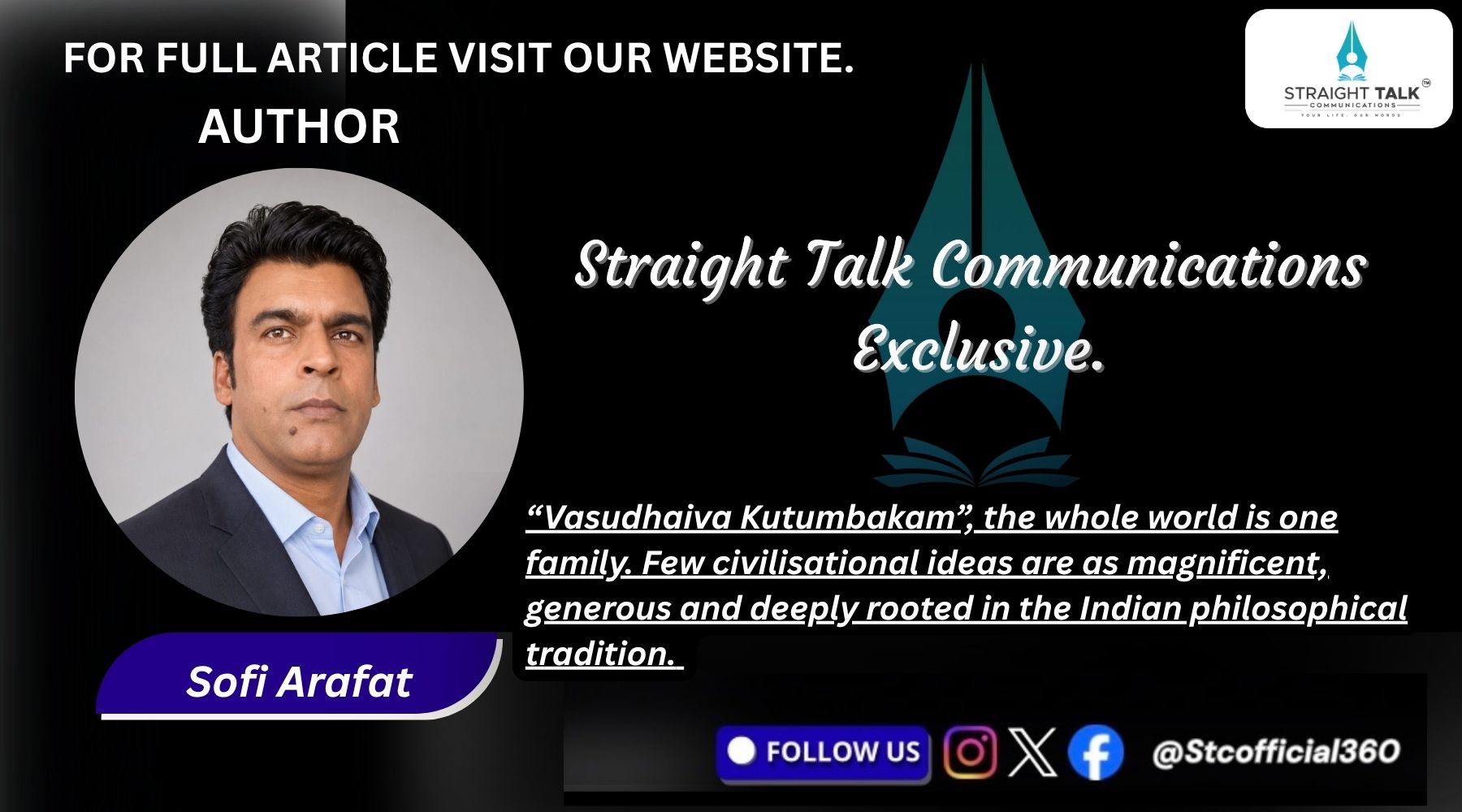
Sofi Arafat
“Vasudhaiva Kutumbakam”, the whole world is one family. Few civilisational ideas are as magnificent, generous and deeply rooted in the Indian philosophical tradition. Yet, in contemporary India, one is tempted to ask an awkward question: who exactly gets invited to the family gathering?
Apparently, everyone, except the Muslim, who is increasingly expected to prove that he belongs.
India’s constitutional promise of equality, fraternity and secularism increasingly sits uneasily alongside a political and social environment in which Muslims are frequently portrayed through the language of suspicion, infiltration and cultural otherness. Human Rights Watch has documented what it describes as unlawful demolitions of Muslim homes and properties and increased vilification of Muslims. It has also reported attacks and intimidation following the 2025 Pahalgam attack. These are serious allegations and deserve scrutiny precisely because the constitutional promise of equal citizenship cannot depend upon religious identity.
The numbers, too, warrant attention. According to Reuters’ reporting on data compiled by India Hate Lab, the organisation documented 1,318 anti-minority hate-speech incidents in 2025, a 13 per cent increase over 2024. It reported that 1,164 of those incidents occurred in states governed by the BJP or its coalition partners. The BJP has disputed the organisation’s methodology and rejected allegations of discriminatory intent. Such disagreements over data, however, should not obscure the larger democratic question: what happens when communal rhetoric becomes sufficiently routine that society begins to treat it as ordinary political vocabulary?
Then there is the increasingly familiar grammar of the bulldozer—a language in which demolition can appear to substitute for due process. Human Rights Watch has criticised demolitions involving Muslim properties where authorities cited alleged illegal construction, militancy or undocumented status, arguing that some of these actions amounted to collective punishment. The fundamental issue is not whether an illegal structure should be removed. The issue is whether the rule of law is applied through transparent procedures, individual accountability and judicial safeguards—or whether identity itself begins to determine how administrative power is exercised.
India’s religious spaces, meanwhile, have increasingly become theatres of political contestation. The violence in Nagpur in 2025, following demands by Hindu nationalist groups concerning Aurangzeb’s tomb, demonstrated once again how contested histories can be repackaged and mobilised in contemporary politics. History deserves scholarship, debate and contextualisation; it should not become an inexhaustible reservoir of grievances from which political mobilisation can be manufactured.
Even food and personal identity have not remained untouched by this transformation. What one eats, what one wears, which historical figures one remembers, which language one speaks and which religious structure one visits can increasingly become markers in a political contest over belonging. The private sphere itself is gradually being pulled into the machinery of public identity.
And so, with a touch of uncomfortable sarcasm, perhaps the celebrated slogan requires a contemporary footnote:
“Vasudhaiva Kutumbakam”—the whole world is one family, provided you pass the ideological, religious, historical and dietary entrance examination.
But the problem is considerably deeper than satire.
India’s contemporary crisis of pluralism cannot be understood without acknowledging the violent histories that have shaped South Asia. The rise of armed Islamist militancy in the region, the Afghan jihad of the 1980s, Pakistan’s subsequent role as a major centre for militant networks and the eventual spread of transnational jihadist ideologies profoundly altered the security and political landscape of South Asia and beyond. The Soviet intervention in Afghanistan and the subsequent international and regional mobilisation around the anti-Soviet jihad played a major role in creating the ecosystem from which later militant movements emerged. Pakistan became a critical arena in that process, with militant infrastructure and ideological networks subsequently producing consequences far beyond Afghanistan.
Kashmir, too, experienced the devastating consequences of armed insurgency, militancy and political violence. Thousands of lives were lost, communities were displaced, families were shattered and an entire generation grew up amid insecurity. None of this history should be minimised or romanticised. Islamic extremism has caused immense human suffering, including among Muslims themselves.
Yet there is an equally important lesson in this history: a society cannot defeat an extremist ideology by reproducing its most corrosive logic in another form.
That is where the contemporary debate becomes uncomfortable.
If extremism teaches people to divide society into permanent categories of “us” and “them”, then democratic India must resist the temptation to construct its own permanent categories of belonging and suspicion. If militant ideologies weaponise identity, a constitutional democracy must not allow identity to become a weapon of governance. If propaganda reduces individuals to religious labels, the republic must insist on seeing citizens as citizens first.
The tragedy would be to allow the logic once associated with extremist politics to seep into mainstream political culture, not because the two phenomena are identical, but because both can exploit fear, historical grievance and social division for political mobilisation.
The danger, therefore, is not simply that Muslims may become socially alienated. The deeper danger is that discrimination can gradually acquire the appearance of normal governance; communal rhetoric can become routine political vocabulary; misinformation can become a substitute for historical understanding; and prejudice can learn to speak in the language of administration.
That would represent something far more consequential than a deterioration in communal relations. It would amount to an erosion of the very idea of India that emerged from the freedom struggle and was subsequently embedded in the Constitution: an India in which citizenship was not supposed to be graded according to religion, language, ethnicity or cultural conformity.
India’s civilisational achievement was never that everyone looked, worshipped or lived alike. Its achievement was the ability—imperfect, contested and often painfully negotiated—to accommodate extraordinary diversity within a shared civilisation.
That composite culture is not a weakness. It is India’s inheritance.
The Muslim contribution to Indian civilisation is not an external footnote to India’s history. Muslim scholars, poets, soldiers, administrators, artisans, entrepreneurs, reformers and ordinary citizens have participated in shaping India’s cultural, intellectual, architectural, linguistic and social landscape for centuries. To reduce that enormous history to contemporary political binaries is not merely historically impoverishing; it diminishes the complexity of India itself.
The same principle must apply in reverse. Acknowledging the contributions and citizenship of Indian Muslims does not require ignoring terrorism, militancy, communal violence or extremist ideology. Extremism must be confronted wherever it appears. But combating extremism and marginalising an entire religious community are fundamentally different propositions.
A constitutional democracy must be capable of holding both truths simultaneously: terrorism must be defeated, and innocent citizens must not be collectively punished; communal violence must be condemned, and communities must not be collectively demonised; illegal construction must be dealt with, and due process must remain non-negotiable.
India does not need a narrower definition of “Vasudhaiva Kutumbakam”. It needs to practise the definition it so proudly quotes.
Because a civilisation that once proclaimed that the entire world is one family should be profoundly uncomfortable if one of its largest communities increasingly feels compelled to prove that it belongs to the family at all.
The question before India is therefore not whether Muslims belong to India.
They do.
The real question is whether India’s political culture will continue to preserve a conception of citizenship broad enough to accommodate the extraordinary diversity that made the idea of India worth defending in the first place.
“Vasudhaiva Kutumbakam” was never supposed to be an invitation with conditions attached.
It was supposed to be a civilisational promise.
(The author is a socio-political activist and former Chairman of the Aishmuqam Municipality.) Email: arafat.aqm@gmail.com
(Disclaimer: The views are of the author and not of the Straight Talk Communications)