



The Power of Mind: The Stories We Tell Ourselves
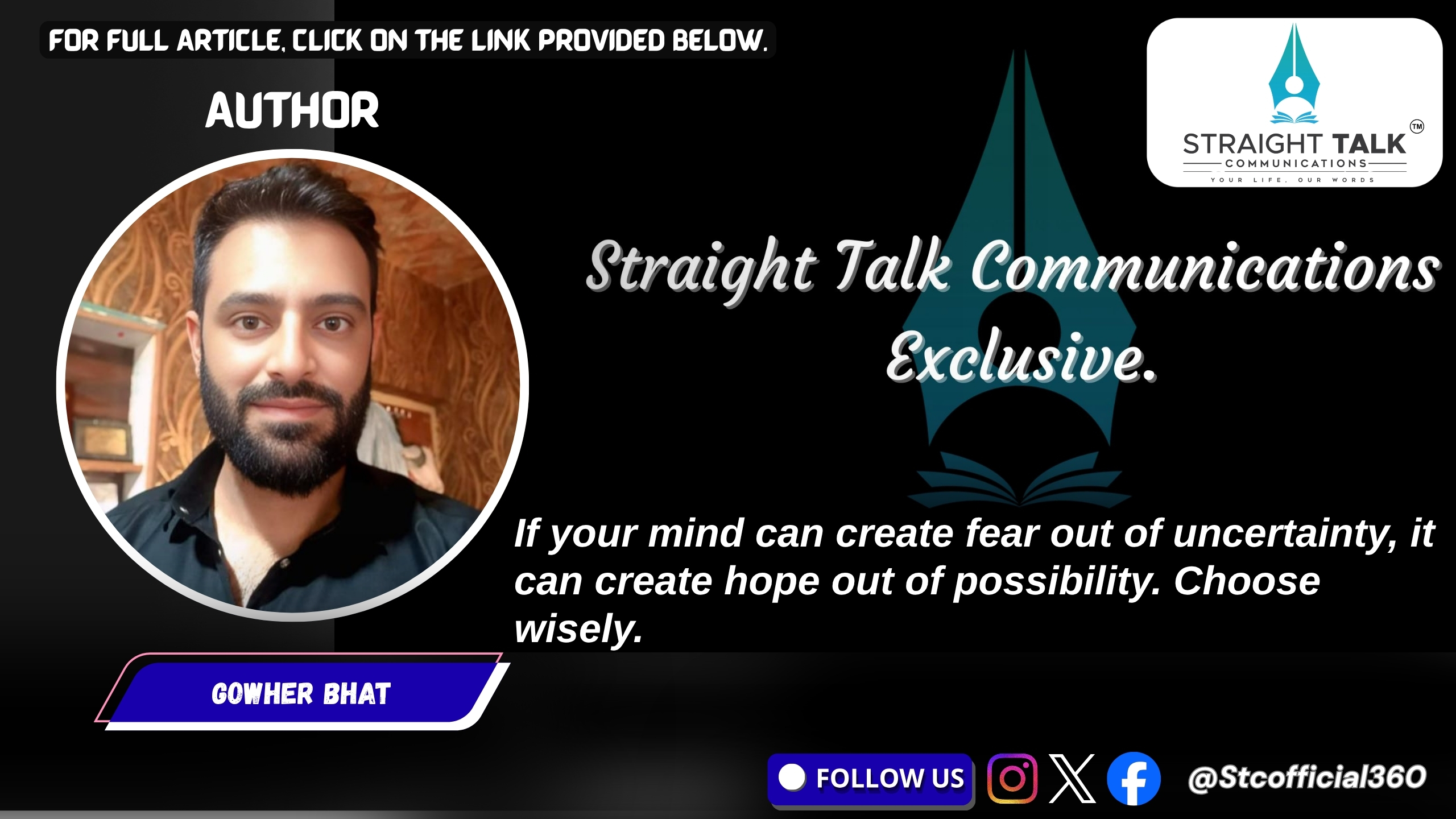
If your mind can create fear out of uncertainty, it can create hope out of possibility. Choose wisely.
Gowher Bhat
Few things shape our lives more profoundly than the stories we tell ourselves. Long before events unfold in the outside world, they take shape within the private landscape of the mind. We imagine conversations before they happen, anticipate outcomes before they arrive, and construct futures long before they become reality. In many ways, human beings live twice, first in imagination and then in experience.
Yet there is a curious imbalance in the way we use this remarkable gift. For reasons rooted in both biology and experience, we often find ourselves imagining the worst before we consider the best. A delayed phone call becomes a source of anxiety. A minor setback appears to be the beginning of a larger failure. A moment of uncertainty transforms into a prediction of disaster. The mind, gifted with creativity and foresight, frequently employs these abilities not to inspire hope but to generate worry.
Most people have experienced this phenomenon. A simple concern enters the mind and gradually expands into a complex web of fears. We begin with a single question, “What if this goes wrong?” and before long, we have mentally rehearsed an entire tragedy. Hours are spent worrying about possibilities that may never materialize. Emotional energy is consumed by events that exist only in imagination. Ironically, the future remains unchanged by our worrying. What changes is our experience of the present.
The modern world provides countless reasons for anxiety. News cycles operate twenty-four hours a day, often emphasizing challenges and concerns. Social media encourages constant comparison, leading individuals to question their progress, appearance, achievements, and worth. Economic uncertainty, social pressures, professional challenges, and personal responsibilities create a climate in which fear can easily flourish. In such an environment, overthinking has become almost a way of life.
Many people mistake excessive worry for preparation. They believe that if they think through every possible negative outcome, they will somehow protect themselves from disappointment. Yet life rarely works that way. Worry does not prevent problems. It merely causes us to experience them twice, once in imagination and once, if they actually occur, in reality. The tragedy is not simply that we worry. The tragedy is that we fail to recognize the untapped potential of the same imagination that fuels our fears. If the mind is powerful enough to imagine the worst, it is powerful enough to imagine the best.
This simple truth deserves far greater attention than it often receives. The imagination itself is neither positive nor negative. It is a tool. Like any tool, its impact depends upon how it is used. The same mind that predicts failure can envision success. The same mind that anticipates rejection can imagine acceptance. The same imagination that creates anxiety can cultivate hope. Yet many people rarely grant themselves permission to explore positive possibilities with the same intensity they devote to negative ones.
Imagine applying the same energy used for worry toward hope. Imagine dedicating the same mental effort spent anticipating failure toward envisioning growth, opportunity, and achievement. The results could be transformative. This is not an argument for blind optimism. Life is not a fairy tale, and genuine challenges cannot be overcome through positive thinking alone. Difficulties are real. Losses occur. Plans fail. Dreams sometimes encounter unexpected obstacles. To acknowledge these realities is not pessimism; it is honesty.
However, there is an important distinction between recognizing challenges and becoming consumed by them. A realistic outlook acknowledges obstacles while remaining open to possibilities. A pessimistic outlook sees obstacles as proof that success is impossible. One perspective creates resilience, while the other breeds paralysis.
History repeatedly demonstrates the power of hopeful imagination. Every significant achievement in human civilization began as a possibility before it became a reality. Every invention existed first as an idea. Every social reform started as a vision. Every masterpiece was once confined to the imagination of its creator. The Wright brothers imagined flight at a time when many believed it would be difficult to achieve. Scientists imagined cures before treatments existed. Writers imagined worlds before readers explored them. Vision has always preceded achievement.
The same principle applies to individual lives. Personal growth often begins with the ability to imagine a future different from the present. A student imagines graduating. An entrepreneur imagines building a business. An artist imagines creating something meaningful. A person facing hardship imagines a season of healing. Without such visions, progress becomes difficult. People move toward the futures they can imagine. This does not guarantee success, but it creates the conditions necessary for pursuing it.
Psychologists have long recognized the influence of mindset on human behavior. Individuals who believe positive outcomes are possible tend to approach challenges differently from those who assume failure is inevitable. They are often more persistent, more adaptable, and more willing to take constructive risks. They view setbacks as temporary rather than permanent. Failures become lessons rather than verdicts. This mindset does not eliminate obstacles; it changes the way people respond to them, and the difference can be profound.
Consider two individuals facing the same challenge. Both encounter difficulties. Both experience uncertainty. Both make mistakes. Yet one interprets every setback as confirmation that success is impossible, while the other views setbacks as part of the learning process. The first individual gradually withdraws, while the second continues moving forward. Over time, these different responses can produce dramatically different outcomes.
The challenge, therefore, is not merely external. It is internal. It concerns the narratives through which we interpret our experiences. Every day, we engage in an ongoing dialogue with ourselves. We explain events. We assign meaning to circumstances. We tell stories about who we are and what is possible. These stories matter because a person who repeatedly tells themselves that they are incapable will eventually begin acting as though it were true, while a person who consistently believes that growth is possible becomes more likely to pursue opportunities for growth.
Thoughts influence actions. Actions shape habits. Habits define lives. This is why mindset is not a trivial matter. It is not merely a collection of positive slogans or motivational phrases. It represents the framework through which reality is interpreted.
The image of light emerging from darkness serves as a powerful metaphor for this truth. Darkness often symbolizes uncertainty, fear, and doubt, while light represents hope, clarity, and possibility. Significantly, darkness is not overcome by fighting it directly. It is overcome through illumination. A single light can change the atmosphere of an entire room. Likewise, a single hopeful thought can begin transforming an anxious mind.
This transformation does not happen overnight. Years of habitual worry cannot be replaced instantly. The human mind naturally gravitates toward familiar patterns. Negative thinking often becomes deeply ingrained through repetition. Yet every meaningful change begins with awareness. The first step is recognizing when fear has become the dominant narrator of our lives. The second step is challenging its authority. The third step is deliberately creating space for alternative possibilities.
Instead of asking, “What if everything goes wrong?” we might occasionally ask, “What if things work out?” Instead of focusing exclusively on obstacles, we might consider opportunities. Instead of assuming rejection, we might allow room for acceptance. Instead of predicting failure, we might imagine success. These questions do not guarantee favorable outcomes. They simply restore balance.
After all, the future remains uncertain regardless of our expectations. Negative assumptions possess no greater claim to accuracy than positive possibilities. Both are forms of speculation. The difference lies in their impact on our present state of mind. One tends to generate fear, while the other encourages hope.
In an age marked by rapid change and widespread uncertainty, cultivating hope is not naïve. It is necessary. Hope sustains resilience during difficult times. It encourages perseverance when progress seems slow. It provides the emotional strength required to navigate challenges without surrendering to despair. Most importantly, hope reminds us that the future has not yet been written.
The stories we tell ourselves today influence the lives we create tomorrow. Perhaps the most important lesson is this: imagination is one of humanity’s greatest gifts. It has the power to create fear, but it also possesses the power to create possibility. We cannot always control external circumstances, but we can influence the perspective through which we view them. If we are capable of imagining every possible failure, then we are equally capable of imagining success.
(STRAIGHT TALK COMMUNICATIONS EXCLUSIVE)