




STC EXCLUSIVE: Jammu’s Flooded Streets Are a Mirror to Its Governance

Anuj Kumar Verma
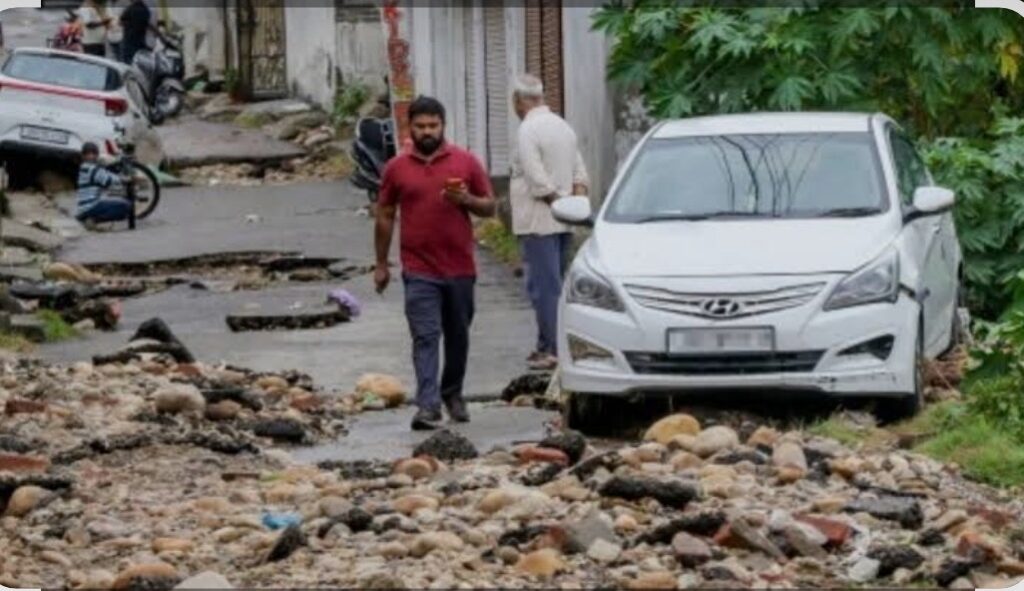
JAMMU, OCTOBER 11 (STC): Jammu did not merely receive record rain on Sunday; it received another verdict on its governance. Officials reported 185.6 mm of rainfall in about three hours, breaking the city’s 71-year October record. Yet the damage was not confined to the extraordinary weather. Water entered homes and shops, vehicles were damaged, landslides blocked the Panjtirthi Sidhra and Sidhra Nagrota stretches, and Raipur Domana saw a man’s body recovered from a flooded stream while a woman remained missing after being swept away. A city that has faced this pattern before should not still be discovering, street by street, where its drainage fails.
The Panjtirthi Sidhra road deserves particular scrutiny. It is a vital link connecting Jammu’s old city with Sidhra and Nagrota on the Jammu–Srinagar National Highway, and it carries substantial daily traffic. Yet it has repeatedly been damaged or blocked by landslides and heavy rain: major damage occurred in 2011 and 2013, catastrophic slope failure damaged the road and water pipelines in 2025, and the stretch was blocked again in August 2026 before Sunday’s landslide. In 2025, its prolonged closure reportedly forced commuters to travel an additional 25–30 km daily. Instead of a permanent engineering solution—slope stabilisation, proper drainage and adequate night lighting—the response has too often been temporary clearance, patchwork and waiting for the next downpour.
The wider affected map was equally familiar: Roop Nagar, Durga Nagar, Shakti Nagar, Raipur Domana, Krishna Nagar, Canal Road, Tallab Tillo, Bhagwati Nagar, Janipur, Dogra Chowk, Panjtirthi and Nagrota. These are not anonymous points on a rainfall map; they are neighbourhoods whose vulnerability has been visible for years. When the same lanes flood, the same nullahs overflow and the same roads become impassable after every intense shower, the problem is no longer merely rainfall. It is the absence of a comprehensive, citywide flood-management plan.
The Jammu Municipal Corporation and other agencies cannot escape responsibility by invoking the cloudburst. No drainage system can remain untouched by such intensity, but a competent civic system should still limit the damage: keep nullahs free-flowing, prevent encroachment on natural water channels, maintain storm-water infrastructure, map flood-prone pockets, and act before the monsoon rather than after the first tragedy. Instead, Jammu has too often seen a make-up policy—desilting before the rains, clearing drains after flooding, issuing advisories, and allowing urgency to fade until the next downpour.
This year itself offered ample warning. During the monsoon, heavy rain had already caused flooding and waterlogging across the region, even as the JMC spoke of intensified drain and nullah desilting. The corporation has repeatedly acknowledged that garbage, plastic and construction debris choke drains and obstruct water flow. If the danger was known, the failure to convert that knowledge into permanent protection is not administrative oversight; it is institutional complacency.
Last year made the stakes unmistakable. Floods and heavy rain across Jammu and Kashmir in 2025 killed 199 people, caused nearly 11,700 livestock deaths, damaged more than 8,400 houses and affected about 77,915 hectares of crop area. In Jammu, the Tawi flooded Jewel Chowk, Bhagwati Nagar and Canal Road, and bridges were damaged or collapsed. Those events should have forced a fundamental redesign of the city’s relationship with its waterways. Instead, Sunday suggests that the lessons were noted, photographed and filed away.
Encroachment, illegal mining and unplanned construction have compounded the danger. Experts have linked the region’s flood severity to occupation of riverbanks and floodplains and to sand mining along the Tawi, both of which weaken natural flood defences. Every structure built in a water’s path, every drain narrowed by debris and every nullah left unmaintained converts rainfall into disaster.
Jammu does not need another round of patchwork. It needs floodplain mapping, removal of dangerous encroachments, protection or relocation of the most exposed settlements, regular desilting, stronger embankments, restored drainage, and storm-water systems engineered for extreme rainfall. The Panjtirthi–Sidhra road, in particular, needs a permanent engineering solution—not another seasonal repair bill. Until the JMC, the district administration, the irrigation and flood-control department and other agencies stop burying their heads in the sand, every heavy shower will remain a civic emergency waiting to happen. Sunday’s loss is not just an act of God; it is the cost of treating flood safety as an annual formality rather than a permanent public duty.
(STRAIGHT TALK COMMUNICATIONS EXCLUSIVE. The author is an Environmental Advocate and Policy Writer. He can be reached at verma.anujjk@gmail.com)