

Doctor’s Day Special: Why Nice Doctors Are Better Doctors
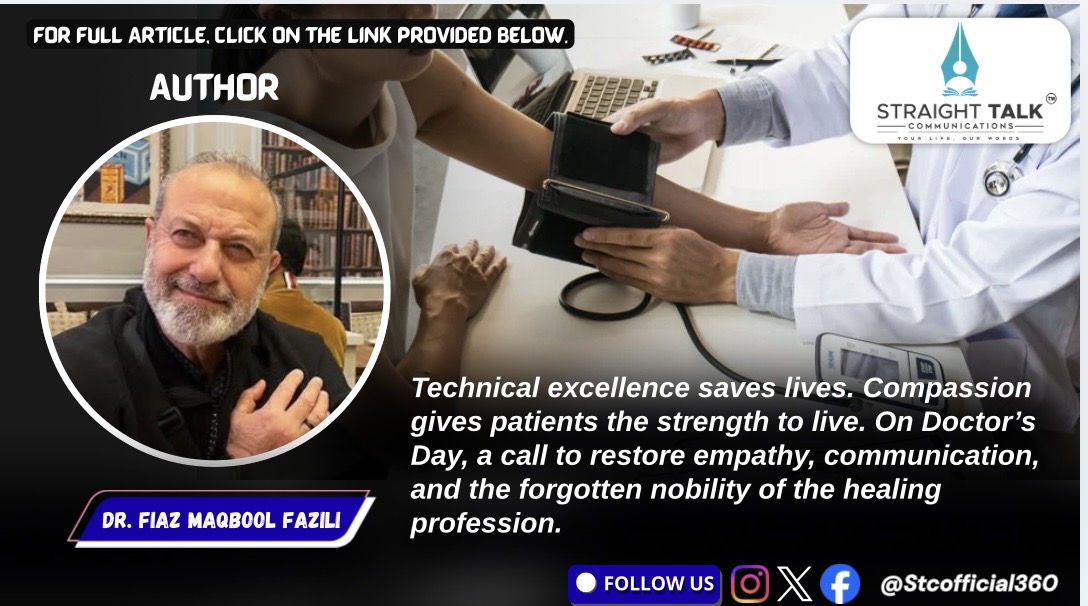
Technical excellence saves lives. Compassion gives patients the strength to live. On Doctor’s Day, a call to restore empathy, communication, and the forgotten nobility of the healing profession.
Dr. Fiaz Maqbool Fazili
There is a moment every doctor should experience—not as the one wearing the white coat, but as the one sitting outside the consultation room, waiting, watching the door, holding a file of reports, and anxiously checking the phone after sending a WhatsApp message to the treating doctor. Has the message been seen? Has the doctor read it? Will there be a reply? Then the two blue ticks appear. Nothing has changed medically, yet everything changes emotionally. Anxiety eases. Hope returns. A simple acknowledgment becomes therapy.
Over the past several years, my own journey from caregiver to care receiver for a close family member has transformed my understanding of medicine far more than any textbook, conference or operating theatre ever did. It reminded me that while doctors treat diseases, patients remember how doctors made them feel.
This Doctor’s Day, perhaps the most important question is not, “Who is the best doctor?” It is, “Where is the real doctor?” Not the doctor with the longest list of degrees, the largest advertisements, publications, prizes, chief guest invitations, ribbon cutting pictures or the loudest claims of being “the first” or “the best,” but the doctor whose presence itself becomes treatment; whose smile lowers blood pressure before the prescription does, and whose words reduce fear before medicines reduce fever.
Medicine has advanced beyond imagination. Artificial intelligence assists diagnosis, robotic surgery performs remarkable procedures, and precision medicine continues to redefine treatment. Yet one complaint dominates patient feedback across the world: “They didn’t listen. They were in a hurry. They never explained. They treated me like another case.” Ironically, patients today are often dissatisfied not because doctors know too little, but because many communicate too little.
People rarely judge a doctor by medical knowledge—they cannot. They judge by kindness, patience, honesty and humanity. Long before patients evaluate our competence, they evaluate our behavioural character. The truth is simple: people do not care how much we know until they know how much we care.
Modern medicine rightly celebrates evidence-based practice. But evidence alone cannot comfort a frightened mother waiting outside an ICU. No laboratory investigation can replace eye contact. No scan can substitute reassurance, tender, loving ,caring words with affectionate reassurance on face. No prescription carries the healing power of genuine empathy.
Communication is not an optional courtesy in medicine; it is clinical care. Explaining the diagnosis, discussing benefits plan of care and risks, talking honestly about uncertainties, listening without interrupting, preparing families for difficult outcomes, with reassuring words , face, body language ( khanda peshani-smiling face )and walking with them even when cure is no longer possible—especially then.
Even when prognosis is not good end-of-life conversations demand not only scientific knowledge but emotional intelligence. Families may eventually forget every laboratory value, but they never forget whether their doctor stood beside them with compassion when hope became fragile.
Unfortunately, communication remains one of the least formally taught clinical skills in many medical institutions. We spend years mastering anatomy, pathology and pharmacology, yet very few teach us how to break bad news, respond to anger, comfort grief, or sit in silence when words fail. Most doctors simply learn from observation—or instinct. Sometimes good mentors shape us; sometimes poor role models damage generations.
Communication should no longer depend upon chance. It deserves structured training. Every medical graduate should leave medical school not only competent with investigations but also competent with conversations—not only technically qualified but emotionally prepared. Because healing begins with trust, and trust begins with listening.
Patients today are no longer passive recipients of treatment. They are partners in care. They deserve dignity, autonomy, understandable explanations, and involvement in decisions affecting their own bodies and lives. This is not merely modern healthcare policy; it is moral medicine.
Good doctors do not impose treatment. They guide, educate, reassure and respect. A patient is never another customer in a waiting room. A patient is someone’s mother, father, child—someone terrified, someone hoping, someone praying, someone placing extraordinary trust in another human being wearing a white coat. That trust is sacred.
The white coat has never been merely professional attire. It has always been a moral garment. Across civilizations, doctors have occupied a unique place in society—not because they possessed extraordinary knowledge alone, but because they combined knowledge with compassion. They were healers, confidants, protectors—almost family during humanity’s most vulnerable moments.
Sadly, medicine today faces pressures unknown to previous generations: crowded outpatient departments, administrative overload, electronic documentation, burnout, commercial competition, performance metrics, private practice economics, social media branding, and the race to become “world-renowned.” These realities cannot simply be ignored. Doctors are human. They experience fatigue, stress, emotional exhaustion, institutional failures and inadequate staffing. All deserve acknowledgment and reform.
Yet even under these pressures, one thing must never become collateral damage—humanity.A warm greeting requires no expensive technology. A reassuring touch costs nothing. A smile consumes no hospital budget. Listening patiently adds only a few minutes, yet often saves countless misunderstandings, complaints and broken trust.
Too often we underestimate the therapeutic value of kindness: a gentle explanation, a chair offered to anxious relatives, an apology when delays occur, an honest admission of uncertainty. These are not signs of weakness. They are signs of strength. Patients rarely expect perfection; they expect sincerity.Perhaps this explains why some doctors become unforgettable despite average infrastructure, while others practising in magnificent hospitals leave patients emotionally abandoned. Patients remember humanity longer than heroics.
As physicians, care providers we also need humility. Titles, positions, Directior,Principal, Dean ,Prof emeritus, medals, nominations, noble prize probable, fellowships and publications enrich professional lives, but they should never inflate professional ego make you haughty, arrogant(Kibr,Takabbur). For every patient, there is only one identity that matters—“My doctor.” That relationship cannot survive arrogance.
Medicine has always warned against pride. Knowledge without humility distances the healer from the suffering human being. The greatest physicians in history were admired not merely because they knew more; they cared more. Every faith tradition celebrates caring for the sick as among humanity’s noblest acts. In Islam, visiting the sick, serving the ill, relieving suffering and showing mercy are acts beloved to Allah. Compassion is therefore not simply professional etiquette; it is a spiritual responsibility.
When doctors remember they are instruments rather than owners of healing, humility naturally follows. Our facial expressions soften, there is no frowning no wrinkles on forehead no tight nose our tone changes, our patience deepens, and our conversations become healing encounters rather than hurried transactions.The Hippocratic Oath should never remain framed on walls or confined to graduation ceremonies. Its true home is daily conduct—in every consultation, every ward round, every emergency, every difficult conversation, every patient and every relative.
Medicine remains among the most beautiful professions on earth. Millions still compete every year to enter medical schools—not because it promises wealth, but because it promises meaning. Few careers allow one human being to relieve another’s pain so directly. Few professions receive blessings from complete strangers for decades after a single compassionate act. Those prayers cannot be purchased. They are earned.
This Doctor’s Day, perhaps we need fewer celebrations and more introspection. Let us ask ourselves one uncomfortable question: When we become patients ourselves, what kind of doctor do we hope to meet? One who rushes, or one who listens? One who displays achievements, or one who displays empathy? One who treats reports, or one who treats people?The answer already exists within each of us.
Medicine does not need more celebrities. It needs more healers. Not merely brilliant minds, but compassionate hearts. Not only skilled hands, but tender words. The future of medicine will certainly be shaped by artificial intelligence, robotics and scientific innovation. Yet patients will continue searching for something no machine can ever provide—human kindness.
So let this Doctor’s Day become more than an annual ritual. Let it become a moral renewal—a day to reclaim the nobility that once defined our profession, revive the forgotten art of listening, remember that every consultation is a privilege, and reaffirm that our greatest instrument is not the stethoscope around our neck, but the compassion within our hearts. Because long after prescriptions fade and operations are forgotten, patients remember one enduring truth:
The best doctors heal the body.
The greatest doctors heal the human being.
(STRAIGHT TALK COMMUNICATIONS EXCLUSIVE. The AUTHOR is a senior consultant surgeon, healthcare quality professional, and writer on medical ethics, patient-centred care and health policy. He writes frequently on compassionate medicine, professionalism and healthcare reforms.)