



Radio Kashmir: Born for the Nation, Forgotten by Prasar Bharati
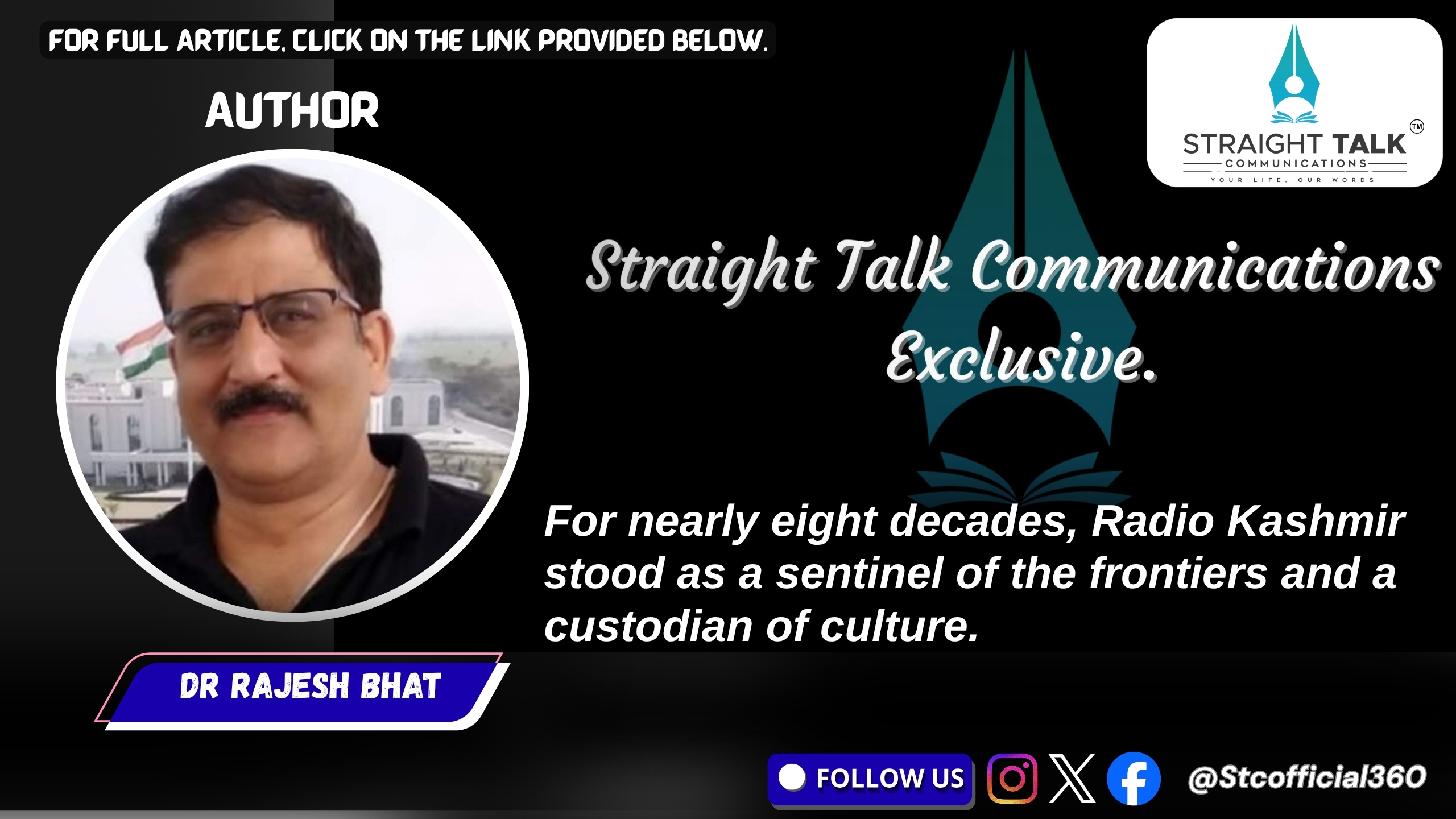
For nearly eight decades, Radio Kashmir stood as a sentinel of the frontiers and a custodian of culture.
Dr Rajesh Bhat
As July 1, 2026 approaches, few institutions in Jammu and Kashmir embody the story of independent India’s resilience, cultural plurality and strategic foresight as profoundly as Radio Kashmir. On that day, the institution would have completed 78 years since its formal commencement on July 1, 1948. Yet, unlike earlier decades when its anniversary was celebrated with pride and participation by broadcasters, artists, writers, musicians and listeners, the occasion now risks passing almost unnoticed. The irony is painful: an institution that once spoke for an entire region, defended the Nation’s interests during war and nurtured generations of cultural icons today stands reduced to a shadow of its former self.
Radio Kashmir was not merely a broadcasting station. It was conceived as a strategic instrument of Nation-building in one of the most sensitive border regions of the world. Its creation came in the aftermath of the Pakistani tribal invasion of Jammu and Kashmir in October 1947. The leadership of independent India quickly realised that military action alone could not secure the minds of people living in border areas. Information, communication and cultural integration would be equally vital.
It was under the stewardship of India’s first Deputy Prime Minister and Information and Broadcasting Minister, Sardar Vallabhbhai Patel, that the idea of strengthening broadcasting infrastructure in Jammu and Kashmir took shape. Radio Kashmir Srinagar and its senior sister establishment at Jammu ( December 1, 1947) emerged not merely as media outlets but as strategic outposts of the Indian state.
Why the Name “Radio Kashmir” Mattered
The designation “Radio Kashmir” was neither accidental nor ornamental. It reflected a carefully crafted strategy during the formative years of the Republic.
The term carried immense psychological and political significance. At a time when Pakistan was aggressively contesting Kashmir’s accession to India, the existence of a broadcasting service explicitly identified as “Radio Kashmir” symbolized the region’s place within India’s democratic framework. The station projected an indigenous voice rather than appearing as a distant relay from Delhi.
The name was coined before Article 370 even existed. This historical fact is often forgotten in contemporary debates. Article 370 became part of the Constitution only on October 17, 1949. Radio Kashmir had already been functioning for over a year before that constitutional provision came into existence.
Consequently, associating the name “Radio Kashmir” with Article 370 was historically flawed. The institution owed its origins not to any constitutional arrangement but to the extraordinary circumstances of 1947-48, when India was struggling to consolidate its sovereignty in Jammu and Kashmir.
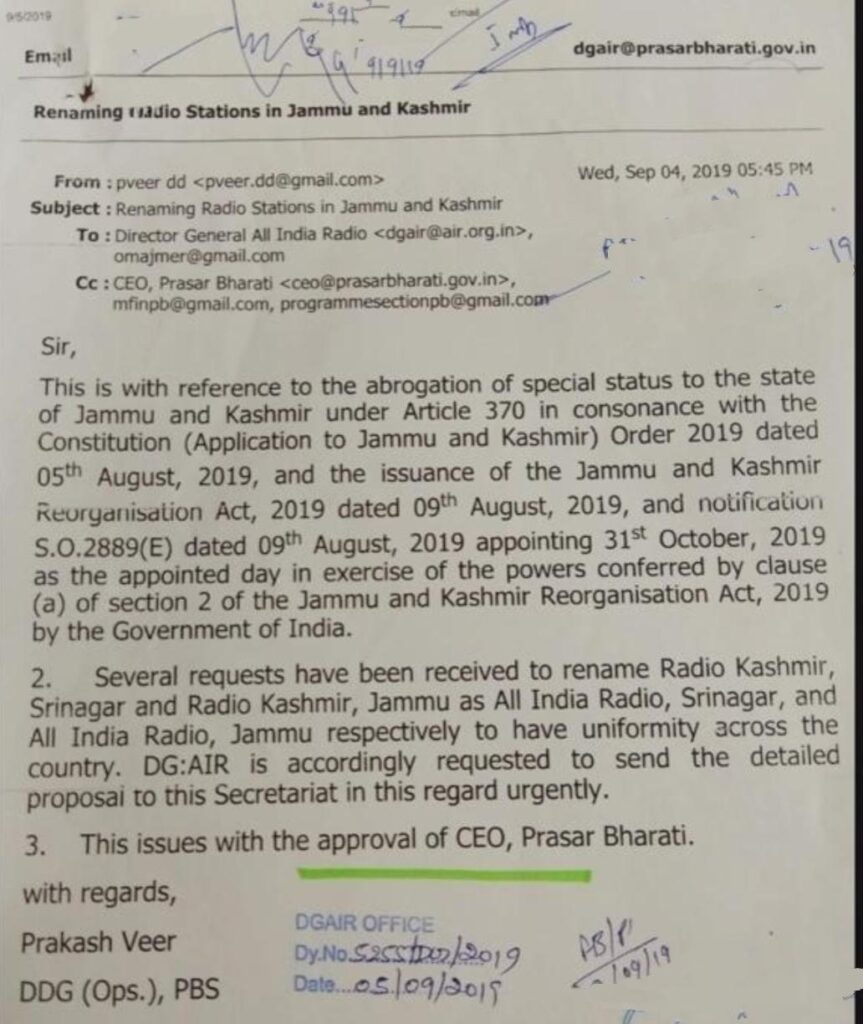
Perhaps one of the most poignant ironies of modern broadcasting history is that the Radio Kashmir brand disappeared on October 31, 2019—the birth anniversary of Sardar Patel himself, the statesman who had championed its establishment and whose strategic vision had given it both purpose and identity.
The Voice that Defeated Propaganda
For decades, Radio Kashmir functioned as the first line of information defence in a conflict-ridden region.
During the Indo-Pak wars of 1947-48, 1965 and 1971, the station became an indispensable source of reliable information. In villages scattered across mountains, valleys and border belts, transistor radios carried its bulletins, announcements and messages.
Its significance was particularly visible during periods when Pakistani radio stations attempted to spread rumours, misinformation and psychological warfare. Radio Kashmir became the trusted alternative.
For countless listeners, its credibility was unmatched. Whenever false reports emerged from across the border, people waited for Radio Kashmir’s bulletins to ascertain the truth.
The station served as a communication bridge between the government and citizens during crises. It helped maintain morale, discourage panic and reinforce national unity.
The same role continued during the insurgency years beginning in 1989 and during the 1999 Kargil War. Even amidst violence and uncertainty, Radio Kashmir remained operational, transmitting news, public advisories and cultural programming.
Its broadcasts became symbols of continuity when normal life itself appeared fragile.
Guardian of Languages and Culture
If Radio Kashmir’s strategic contribution was remarkable, its cultural contribution was extraordinary.
For generations, it served as the principal platform for the promotion and preservation of Kashmiri, Dogri, Gojri, Pahari, Ladakhi and other regional languages.
Long before digital media and satellite television arrived, Radio Kashmir brought literature into homes.
Its studios echoed with the voices of poets, dramatists, storytellers and scholars. Radio plays became cultural events. Literary discussions stimulated intellectual discourse. Folk music recordings preserved traditions that might otherwise have vanished.
The institution nurtured regional creativity in a manner few organisations could match. Many of Jammu and Kashmir’s finest writers, broadcasters, musicians, singers, actors and intellectuals either began their careers at Radio Kashmir or maintained long associations with it.
Generations grew up listening to programmes that celebrated local traditions while simultaneously strengthening national integration. For many artists, receiving an invitation from Radio Kashmir represented recognition and prestige.
The list of personalities associated with Radio Kashmir over the decades reads like a cultural history of Jammu and Kashmir itself.
Writers, poets, dramatists, broadcasters, musicians and intellectuals found in the station a platform that respected talent rather than commercial popularity.
Its programme executives, announcers, producers and engineers collectively built an institution admired throughout the broadcasting fraternity.
Many broadcasters trained at Radio Kashmir later emerged as national-level media professionals.
The Slow Decline
Yet institutions rarely die suddenly. More often, they are weakened gradually through neglect.
The decline of Radio Kashmir was not caused by lack of relevance. The strategic, cultural and linguistic challenges that justified its creation remain alive today.
Instead, the institution appears to have suffered from a sustained erosion of manpower and vision.
Where once there were teams of producers, scriptwriters, announcers, translators, artists and engineers creating original content, many stations now struggle with skeletal staffing. The once-vibrant centres at Srinagar and Jammu increasingly resemble relay stations rather than content-generating cultural institutions.
Original programming has shrunk. Recruitment has stagnated. Institutional memory has diminished. The generation that built Radio Kashmir is retiring or has already retired, often without successors being trained to inherit their responsibilities.
A Strategic Blind Spot
Perhaps the most troubling aspect of Radio Kashmir’s decline is the strategic vacuum it creates.
Jammu and Kashmir remains one of the most sensitive border regions in the world. Information warfare today is more sophisticated than ever.
Across the border, Pakistan continues to invest in media outreach directed at audiences in Jammu and Kashmir.
Reports over the years have pointed to the existence of multiple high-powered broadcasting facilities operating close to the Line of Control and the International Border. In such an environment, weakening indigenous public broadcasting appears counterintuitive.
The founders of Radio Kashmir understood that broadcasting was not merely entertainment. It was strategic communication. A transmitter was as important as many other instruments of statecraft because it shaped perceptions, countered misinformation and strengthened public confidence.
That logic remains valid in 2026.
The Loss of a Brand and an Identity
The replacement of the Radio Kashmir identity with Akashvani in 2019 represented more than a change of nomenclature.
For many listeners, artists and former employees, it marked the disappearance of a historic brand forged under extraordinary circumstances.
The decision overlooked the historical context in which the name had originated.
Radio Kashmir was never a constitutional symbol linked to Article 370. It was a strategic broadcasting identity born out of the national security challenges of 1947-48.
Its removal, therefore, appeared disconnected from the realities that had originally necessitated its creation.
An Anniversary in Silence
The greatest tragedy of Radio Kashmir’s seventy-eighth anniversary is not merely that a name has disappeared.
It is that an institution once alive with creativity, purpose and public engagement risks commemorating its founding day without the people who gave it meaning. The corridors that once witnessed vibrant artistic exchanges increasingly echo with absence. An institution that helped India defend its narrative during wars, preserved endangered languages, nurtured generations of cultural talent and strengthened national integration now confronts an uncertain future.
The story of Radio Kashmir is ultimately not about nostalgia. It is about recognising the enduring relevance of an institution conceived with remarkable foresight.
Its founders understood that culture and communication were inseparable from national security. They understood that border regions needed voices rooted in local realities. They understood that language, music, literature and public trust were strategic assets.
As July 1, 2026 arrives, the anniversary of Radio Kashmir Srinagar should therefore serve not merely as an occasion for remembrance but as an opportunity for introspection.
The question is not whether Radio Kashmir belonged to the past. The question is whether India can afford to forget the lessons that led to its creation in the first place.
TVIts decline is not merely the decline of a broadcasting station. It represents the fading of a vision that once combined strategic wisdom with cultural confidence—a vision whose relevance has perhaps never been greater than it is today.
(STRAIGHT TALK COMMUNICATIONS EXCLUSIVE. The author is a senior journalist, author and media analyst with a PhD in Strategic Media Affairs. He has extensively written on broadcasting, media policy, cultural heritage, with a particular focus on Jammu and Kashmir and the role of public service broadcasting in nation-building. He can be approached on raajbhat@gmail.com)