

SUNDAY BYTES: My Tryst with SKIMS – A Last Resort, A Lifeline, A Legacy
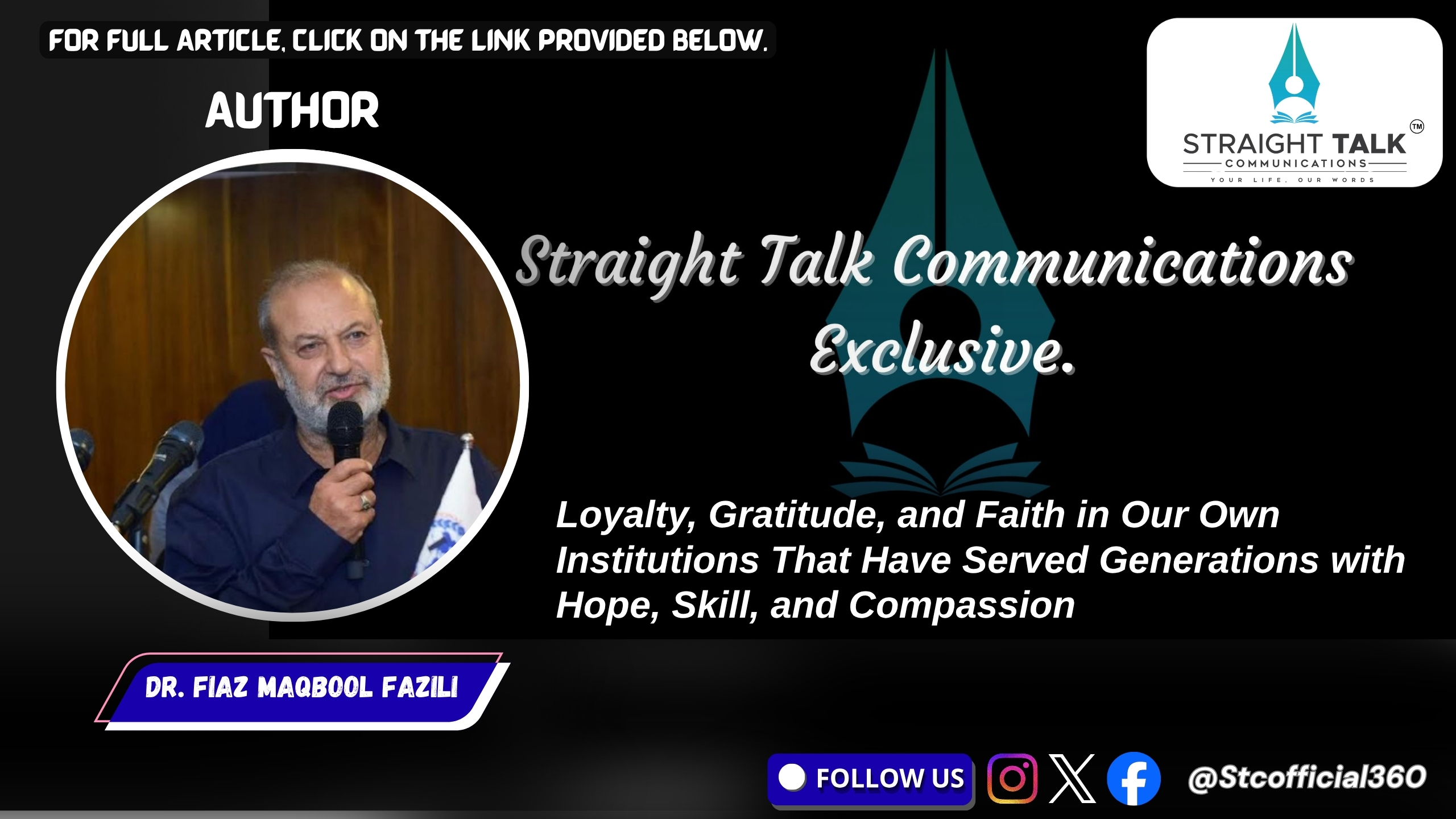
Loyalty, Gratitude, and Faith in Our Own Institutions That Have Served Generations with Hope, Skill, and Compassion
Dr. Fiaz Maqbool Fazili
For generations of Kashmiris, particularly those from lower- and middle-income families, the Sher-i-Kashmir Institute of Medical Sciences (SKIMS) has been more than a hospital. It has been a destination of hope—a place where ordinary people, often with limited means, arrived with extraordinary expectations. For many, it remains the final referral centre, the last resort when all other options have been exhausted.
My association with SKIMS is not merely professional; it is deeply personal. Like thousands of doctors trained within its walls, I owe much of my professional foundation to this institution. To understand SKIMS today, however, one must revisit the vision that created it.
When SKIMS was conceived in the early 1980s under the leadership of Sheikh Mohammad Abdullah and shaped by visionary administrator Ajit Kumar Nagpal with passionate dedicated staff, healthcare in Kashmir was vastly different. Advanced medical care was largely unavailable within the Valley. Patients requiring specialized treatment often had to travel outside Jammu and Kashmir, enduring financial hardship and emotional distress. SKIMS was envisioned as a tertiary-care hospital, a centre of excellence for research, teaching, and super-specialty services. It was designed not merely as another hospital but as a comprehensive academic medical institution capable of bringing world-class healthcare closer to the people of Kashmir.
The vision succeeded. Alhamdulilah!
Over the years, SKIMS evolved into one of the most respected healthcare institutions in the country. It earned national and International recognition and was counted among India’s leading hospitals. Talented residents, consultants, scientists, and academicians from across the country and abroad sought opportunities to train and work here. The institution became a beacon of academic medicine in a region facing unique geographical and political challenges. Like every great institution, SKIMS has experienced periods of growth as well as periods of stagnation, ups and downs. At a time when it was steadily progressing towards becoming a destination for medical tourism and advanced healthcare, Kashmir was engulfed in disturbances and prolonged instability. The conflict impacted every sector of society, including healthcare. Yet, through some of the most difficult years in Kashmir’s history, turmoil, the covid, floods etc the institution continued to function. Many of the staff travelled long distances, often under extraordinary circumstances, to ensure that patients continued to receive care. While infrastructure, resources, and manpower frequently lagged behind growing /overwhelming demand and patient overload, commitment rarely did. This is a chapter of SKIMS’ history that deserves recognition.
One of the greatest misconceptions about healthcare is the assumption that the quality of a doctor is determined solely by the appearance of the institution in which he or she works. The truth is far more nuanced. The doctors, Nurses, paramedics, ambulance drivers and other healthcare professionals working at SKIMS are as talented, knowledgeable, and dedicated as their counterparts anywhere in India or abroad. The institution’s alumni have distinguished themselves across the globe, occupying leadership and consultant positions in renowned hospitals, universities, and research centres in the United States, the United Kingdom, the Middle East, and elsewhere. Lest we forget! Whenever the achievements of Kashmiri doctors abroad make headlines, we celebrate their success. What we often forget is that many of them received their foundational training at institutions like SKIMS.I can personally testify to this reality. When I appeared for overseas assessments, examiners evaluated not only theoretical knowledge but also practical competence and hands-on clinical competence. They were often surprised that a doctor with post grdaute degree in General surgery trained in a remote, conflict-affected region possessed advanced procedural skills—including pulmonary artery wedge catheterisation, temporary pacemaker insertion, central venous catheterisation, chest tube insertion, trauma management and other critical care interventions and emergency procedures comparable to international standards. Those skills were not acquired by accident. They were the result of rigorous training, exposure, mentorship, and clinical experience gained at SKIMS. The institution provided many of us with the confidence and competence to compete globally. This is why it pains me when some individuals who once benefited from the institution later question the competence, education, or professional standards of its doctors. The very institution that helped build careers and credentials should not become a target of unfair criticism or misplaced contempt.
Constructive criticism is essential; institutional denigration is not. Let us also acknowledge an uncomfortable reality. Healthcare today is far more complex than it was four decades ago. Medical technology is advancing and expensive. Infrastructure requirements are enormous. Supply chains must be efficient. Human-resource demands continue to grow. Public expectations have risen dramatically. Accessibility and affordability have become the defining healthcare challenges of our time, most of us can’t afford corporate hospital services. In this context, SKIMS remains indispensable.Those who casually suggest seeking treatment outside Kashmir should speak to families who travel to Delhi, Mumbai, Chandigarh, or Chennai for prolonged treatment. Ask them about the costs of travel, accommodation, investigations, consultations, hassles of waiting in long queues, and repeated visits. Ask them about waiting in crowded corridors, enduring unfamiliar climates, navigating large metropolitan hospitals, and exhausting life savings while awaiting appointments. For many families, such journeys are financially devastating.
SKIMS, despite its limitations, provides advanced healthcare at the doorstep of the people. Its value cannot be measured merely in beds, buildings, or equipment; it must also be measured in accessibility, affordability, how it caters to overwhelming patient load and social equity. This does not mean that the institution is free of challenges when its wings of flight and fight (autonomy) has been clipped. Infrastructure requires modernization. Equipment procurement and maintenance systems need strengthening. Workforce shortages must be addressed. Administrative processes should become more efficient. Many believe that after the dilution of its original autonomy, decision-making became much slower, bureaucratic and institutional flexibility diminished. These are genuine concerns. However, they should inspire reform rather than despair.
Recent achievements demonstrate what is possible when skilled professionals are supported by committed leadership. Complex interventions and advanced procedures, including bone marrow transplantation, have shown that SKIMS possesses the expertise required to deliver highly specialized care within Kashmir itself. These successes reaffirm a simple truth: our doctors are not lacking in talent; they often work despite limitations that would challenge any institution. Give them adequate infrastructure, reliable resources, modern technology, supportive policies, and professional encouragement, and they will continue to achieve remarkable outcomes. Yet the future of SKIMS is not solely the responsibility of administrators and healthcare workers. It belongs to all of us.
Every patient attendant, visitor, citizen, policymaker, journalist, and healthcare professional has a role to play. We must treat this institution as our collective asset. Hospital premises should not be littered. Overcrowding must be minimized. Hygiene, particularly in washrooms and public spaces, must be respected. Public infrastructure survives only when the public takes ownership of it.Equally important is responsible public discourse.The media performs an indispensable role in ensuring transparency and accountability. Healthcare institutions must remain open to scrutiny. Negligence, if established, should never be ignored. Patients and families deserve answers, fairness, and justice. However, there is a difference between accountability and sensationalism.
Complex or adverse medical events, grievance redressal require careful investigation through established clinical, administrative, and legal processes. Premature judgments, incomplete narratives, and media trials often create confusion rather than clarity. Overnight, everyone becomes a super-specialist commenting on highly technical procedures without access to the full facts. Such approaches neither help patients nor strengthen institutions. Feedback is the oxygen of improvement, but criticism must be informed, balanced, and constructive.
Institutions thrive on trust, accountability, participation, and collective ownership—not cynicism. SKIMS, built with vision and strengthened by generations of dedicated professionals, remains a lifeline and a beacon of hope for countless Kashmiris. Strengthening our hospitals is a shared responsibility—one I deeply believe in and strive to fulfil through my own contributions, guided by both moral conviction and religious values. Every contribution matter, no contribution is trivial —whether time, expertise, philanthropy, or donating a wheelchair, bed, equipment, or even sponsoring a ward in memory of a loved one as Sadaqah Jariyah. At the same time, hospital administrations should institutionalise patient feedback by making discharge feedback forms mandatory and holding regular interactions with patients, attendants, the media, and the public. Listening to those we serve is essential for transparency, accountability, and continuous improvement.
The Hon’ble Minister’s regular field visits and Gemba Walks are welcome steps towards greater accountability. The next priority should be reducing the overwhelming patient load at SKIMS through a robust referral policy, strengthened secondary hospitals, e-consultations, and an electronic referral network. Not every patient requires treatment at a tertiary care centre; appropriate triaging would improve access for those who truly need highly specialised care.
A Humble Appeal to SKIMS Alumni especially non-resident overseas. The institution that shaped our careers deserves our gratitude and support. Knowledge, skills ,wealth and expertise are an “amānah (sacred trust) to be shared. Let us give back through teaching, mentorship, research, skills transfer, sponsoring fellowships, or philanthropy, while creating opportunities for young healthcare professionals to train at leading centres in India and abroad and bring home new skills and innovations. Encouragingly, the present leadership at SKIMS appears open to suggestions, feedback and committed to strengthening services, upgrading infrastructure, improving systems, and rebuilding institutional morale. These efforts deserve the support of government, healthcare professionals, alumni, civil society, and the public alike.
SKIMS is more than a hospital—it is one of Kashmir’s greatest public institutions and, for countless families, the last resort for the poor and the middle class, a centre of excellence, and one of Kashmir’s greatest public institutions to knock at when all else fails. For generations, it has been a lifeline, offering expert care and hope to those who need it most. Let us protect it, strengthen it, and help it grow, and believe in it, for in preserving SKIMS, we preserve hope for generations to come.
(STRAIGHT TALK COMMUNICATIONS EXCLUSIVE. The author is a former SKIMS alumnus, clinical auditor, and international expert in healthcare quality improvement, patient safety, clinical governance, and health policy. He has contributed extensively to healthcare quality standards, service redesign, reforms and institutional improvement.)