


The Call I Never Answered
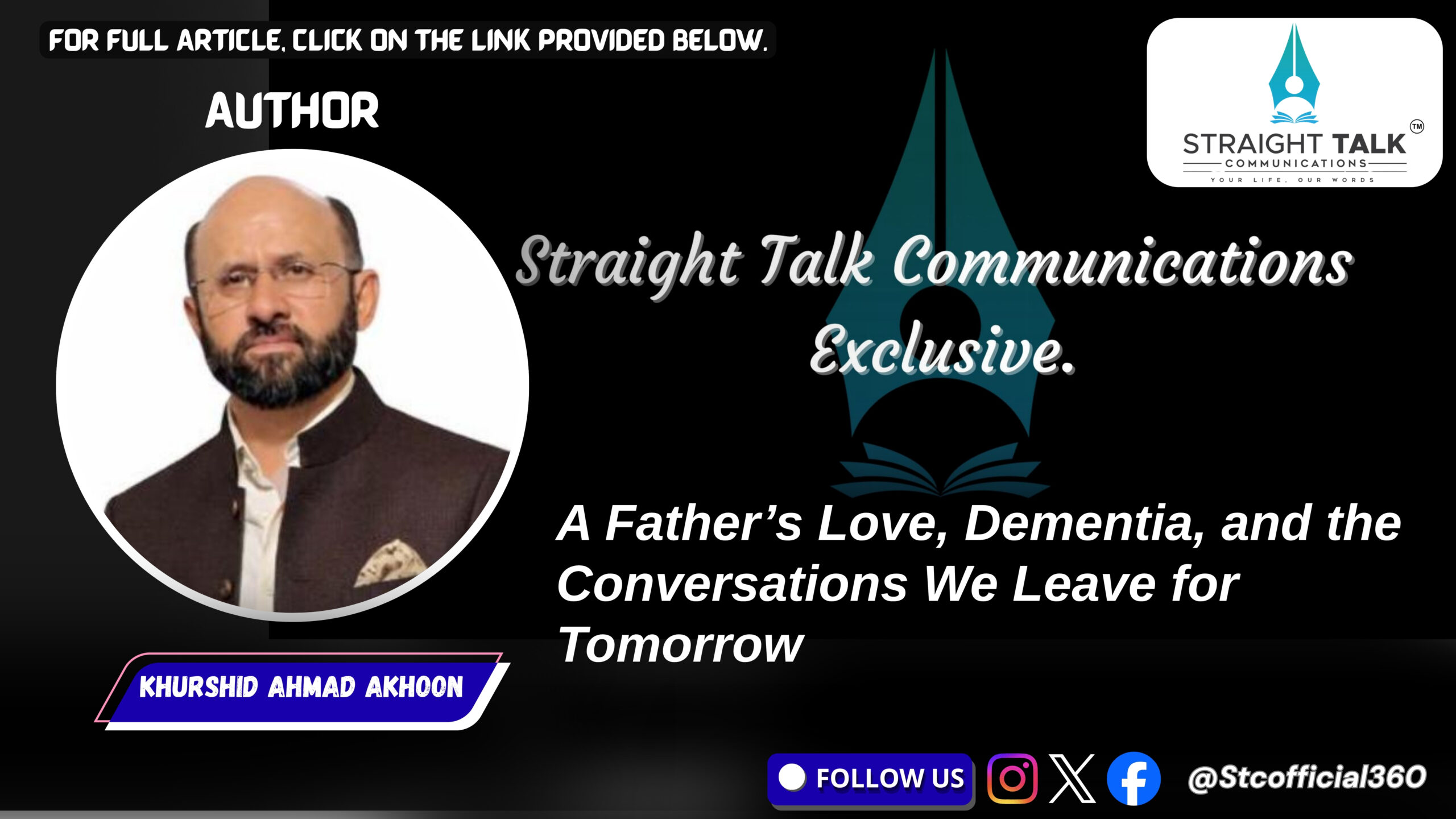
A Father’s Love, Dementia, and the Conversations We Leave for Tomorrow
Khurshid Ahmad Akhoon
Some voices are not ignored because they are unimportant.
They are ignored because we believe there will always be another chance to hear them.
Only later does life teach us that silence often carries the loudest echoes.
My father has always been a man of few words. He never believed in long speeches or dramatic displays of affection. His love was quiet, constant, and dependable—like the shade of a great tree under which one rests without ever thinking who planted it.
While I ran through life chasing ambitions, he remained where fathers often stand: quietly making sure the sun never burned me too much.
As a child, I would kiss his cheek and run away laughing. He would smile—a smile that filled our home with warmth. To me, he was the strongest man in the world.
I did not know then that even the strongest people grow tired.
He advised me, corrected me, and sometimes scolded me. As children, we often mistake discipline for strictness. As adults, we discover that those stern words were acts of love, carefully wrapped in responsibility.
Then came the age when I began saying, “I already know.”
Perhaps that is the most unfortunate stage of adulthood—not when parents stop caring, but when they stop advising because they fear their children may feel offended.
I believed I had grown wiser.
In reality, I had simply stopped listening.
Then smartphones entered our lives.
With them came endless notifications, meetings, deadlines, and distractions.
One evening, my phone rang.
The screen displayed my father’s name.
I looked at it.
I hesitated.
“I’ll call him later,” I thought.
It is astonishing how light the word later feels when we say it—and how unbearably heavy it becomes when we can no longer act on it.
That night, I looked at my phone again.
One line stared back at me:
Incoming call — not answered.
I locked the screen.
But that sentence never disappeared from my heart.
For some time afterward, my father called more frequently—sometimes several times a day.
Often I was busy.
Sometimes I was in meetings.
Occasionally, I simply assumed the conversation could wait.
I wondered why he called so often.
Today I know the answer.
He did not need anything.
He simply wanted to hear his son’s voice.
Then, almost unnoticed, the calls became fewer.
Eventually, they stopped altogether.
At first I assumed he had accepted that I was always occupied.
The truth was far more painful.
He had begun forgetting.
First dates.
Then directions.
Then telephone numbers.
And one day—
my name.
I was sitting beside him when he looked at me with a long, searching silence before gently asking,
“Where have you come from?”
In that single question, something inside me collapsed.
The diagnosis was dementia.
His memories were slowly leaving him.
Ironically, that was when I desperately wanted the phone to ring again.
I wished he would call repeatedly.
I wished he would ask, “Son, where are you?”
But by then, he had forgotten how to make the call.
One day I sat beside him holding his hand.
There was a faint light in his eyes.
Slowly, he spoke my name.
I froze.
Then, after a long pause, he softly whispered,
“Abaji…”
The same affectionate word I had used for him throughout my childhood.
In that single word lived an entire lifetime.
I was once again the little boy
His memory had not fully returned.
The sentence was incomplete.
But love was complete.
That was the day I understood something medicine itself often reminds us.
Memory lives in the brain.
Love lives somewhere deeper.
Even when memory fades, love often remains.
Dementia does not erase humanity.
People living with dementia are not being difficult or stubborn; they are living with a disease that gradually steals memory while leaving emotions remarkably intact. They may forget names, faces, and places, but they often continue to recognize kindness, patience, affection, and the emotional tone of the people around them.
If someone with dementia asks the same question repeatedly, answer it patiently.
Do not embarrass them.
Do not lose your temper.
Their memory may be failing.
Their feelings are not.
If your parents can still recognize your name today, consider it one of life’s greatest blessings.
Call them.
Sit beside them
Look into their eyes.
Listen to stories you have heard a hundred times.
One day, those stories may disappear.
And one day, they may no longer remember your name.
Life does not always offer a second chance to kiss the cheek we ignored, to hold the hand we were too busy to hold, or to answer the call we believed could wait until tomorrow.
My father sometimes remembers my name.
Sometimes he does not.
But whenever he does, I become that little boy again, running through childhood with laughter, believing nothing in the world could ever change.
Perhaps that is the greatest lesson a father can teach—even when words begin to fade.
As long as a father is alive, his presence is not merely a blessing.
It is one of life’s greatest gifts.
(STRAIGHT TALK COMMUNICATIONS EXCLUSIVE)